
Written by Ali Blackdiamond
To read Part 1, visit this location
Rainbow and Black Sabbath Era
Originally formed with Elf’s members and then going through many line up changes over the years, in 1975 Ronnie joined the legendary Deep Purple guitarist Richie Blackmore, to form Rainbow.
The name was inspired by the ‘Rainbow Bar and Grill’ in Hollywood, where Ronnie and Richie spent some of their free time.
The bands debut album entitled ‘Richie Blackmore’s Rainbow’ was released in 1975 and it was the start of all the medieval fantasy lyrics that Ronnie became so famous for, including such classics as ‘Catch The Rainbow’ and ‘The Temple Of the King’. His powerful and unique vocals now exploded into life with true heavy metal style.
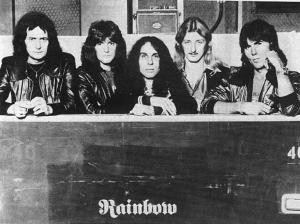
The band started touring the world when their second album ‘Rising’ was released and Ronnie was at home up there on the stage delivering his magical songs to the world. The masterpiece on the album regarded by many fans was ‘Stargazer’ at 8 minutes and 26 seconds long, recorded with the Munich Philharmonic Orchestra.
As demonstrated with the above mentioned songs, Ronnie wrote some of the first power metal lyrics whilst in Rainbow dazzling fans with a whole spectrum of colour.
The following excerpt is taken from an early Rainbow radio interview in 1975 –
Richie’s thoughts of Ronnie – ‘Ronnie has an incredible voice, a very good voice, and is very good at improvising. I found this lacking in my former bands.’
Ronnie – ‘We want to make music, we don’t care about the stage set and everything that goes with it, but we have to to keep up with other bands. We just want people to enjoy the music, the theatrics need to come second to the music.’
The next and last album Ronnie was to appear on with Rainbow was ‘Long Live Rock ‘n’ Roll’ released in 1978, as with the previous ones on the Polydor label. The album includes yet more classics, including the title track, ‘Kill The King’, ‘Lady Of The Lake’, and ‘Gates Of Babylon.’
After the world tour for the album, during 1977 – 1978, Blackmore decided he wanted to change the bands direction to make it more commercial, moving away from the ‘sword and sorcery’ theme. Ronnie didn’t agree with this and decided to move on.
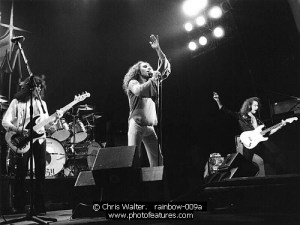
Ronnie then replaced Ozzy Osbourne in Black Sabbath in 1979. The band enjoyed something of a resurgence with the release of ‘Heaven And Hell’ in 1980. Ronnie tells the story in this RockEyez interview –
‘You spent 4 years with Rainbow and then eventually you left the band due to musical differences and were almost immediately recruited by Black Sabbath as their new front man to replace Ozzy Ozbourne. How did that all come about?’
‘Well it wasn’t quite that immediate. When I was gone from Rainbow, they carried on and I was living in Connecticut at the time. I had gone back to L.A. where I had come from because that was more of where the hub of the industry was but I really didn’t know anybody. Then, probably, about six months later, I saw Tony (Iommi) in a place called “The Rainbow” and we went up to the place where they were rehearsing. Ozzy wasn’t there at the time (Thank God!), they played me some things, I met Geezer and Bill, then they played me a song and were like, “Can you do anything with it?” And I said, “Give me a moment.” I went over, wrote some things down, came back and said, “Ok, let’s try it!” It turned out to be the song “Children of The Sea.” From that moment, Tony was like, “I don’t want to play with Ozzy anymore, I want to play with him!” So I got into the fold that way.’
‘You had some pretty big shoes to fill at the time. Were you ever nervous about how the long time Black Sabbath fans would respond to you?’
‘I was never nervous because my place in the band was not to be Ozzy, but to be the singer who just performed and wrote on the “Heaven and Hell” album. You can’t replace a legend… you can only try to become one yourself.’
‘You ended up recording 3 albums (initially) with Black Sabbath. “Heaven & Hell,” “The Mob Rules” and “Live Evil” which are all just about considered classics now by Sabbath fans and metal fans alike. Did you realize or think that, at the time, you were taking your first steps to becoming a legend?’
‘My aim was never to be a legend, but to be as good inside Sabbath as I could. The strength of the “Heaven and Hell” album and those that followed propelled all of us into higher regions.’
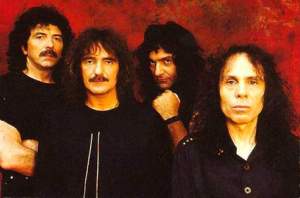
The Heaven and Hell album, showcasing such songs as Die Young, Children Of The Sea and Neon Nights attained gold certification in April 1982 and was the only Black Sabbath album to do so.
The music for the song Heaven and Hell was written mainly by Tony and all lyrics were written by Ronnie. He later explained that the song is about ‘how every individual has ‘heaven and hell’ inside him or herself, as well as the ability to choose good or evil’.
Mob Rules was released in November 1981, including such classics as Voodoo and The Mob Rules.
In the ’30 Years Of Heaven And Hell’ interview, Ronnie said ‘It was very different this time, we hired a studio and it made for a different kind of attitude, it made it a lot harder for me. It wasn’t happy like ‘Heaven and Hell’ was, I found the process a lot more difficult.’
When asked about ‘Live Evil’ which was released as a result of the Mob Rules tour, Ronnie said ‘During the mixing of that album things fell apart, it was Vinnie and I versus Tony and Geezer, but I never knew why. So these problems led to the end of my role in Black Sabbath that time.’
Ronnie rejoined Black Sabbath again in 1992 to record Dehumanizer, their 16th studio album, the first Sabbath album in over a decade to feature Ronnie on vocals.
Ronnie spoke of the reunion – ‘Geezer approached me at a Dio show and that planted the seed. We started to write but it wasn’t a happy situation and it spilled over into the tour again.’
Ronnie’s involvement with Black Sabbath ended again in November 1992, when he was told they would be opening for Ozzy Osbourne at the Casa Mesa reunion shows. Ronnie said, ‘I wasn’t happy with comments made by Ozzy to other band members, so I refused to play. The band wanted to play, so off they went and I was no longer in that band, again.’
To be continued …..


 Click image to watch the video


 Metal Shock Finland (World Assault )
Pingback: Ronnie James Dio:The Man Who Stood Up And Shouted Part Three « Metal Shock Finland (World Assault )