
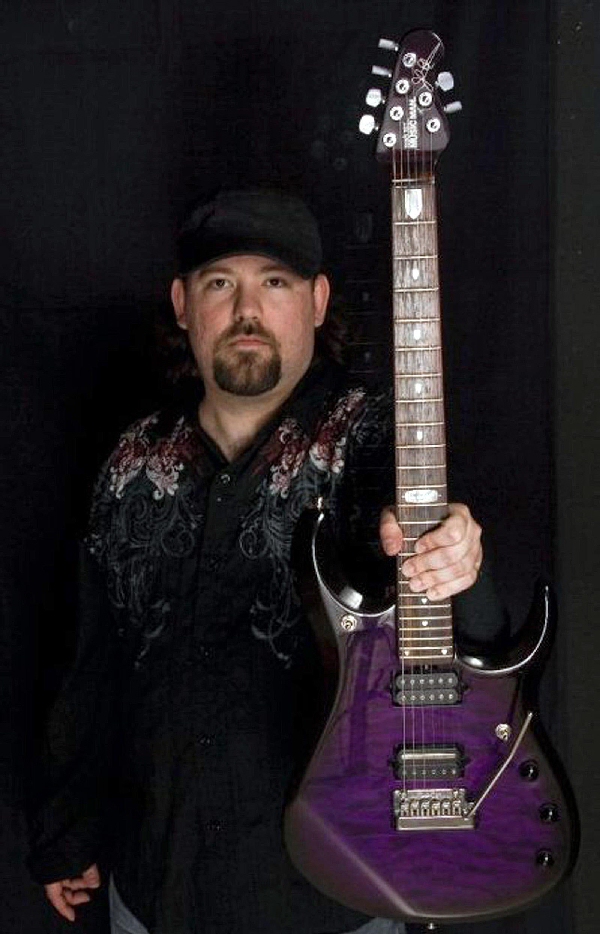
Interview by Teresa Hopkins
Oklahoma, a state in the south central Great Plains of the United States, is known for being the home of several notable musical artists. Usually Garth Brooks, Reba McEntire, Blake Shelton, or Carrie Underwood come immediately to mind, but this area has been ripe with talent in the rock genre for a long time. Kevin Wale, Oklahoma native and guitarist of BIPOLAR ECHO, is one who seems intent on carrying the torch for Rock & Roll. This guitar player from the panhandle cut his chops listening to guys like Steve Vai, George Lynch, and Steve Lukather, to name a few. He was, however, not immune to the stylings of classic country artists, but that only seems to have given him a broader scope of exposure as well as perspective.
Sooner or later, Kevin needed to find some like-minded individuals to help him on his musical quest. Enter Amber Fesmire (Lead Vocals, Keyboards), Michael Kennedy (Drums) and Ramiro “Tiny” Rosalez (Bass), and here’s a band ready to show the world that Oklahomans can rock with the best of them.
I have to admit, I’m guitar-biased; that’s usually the first thing I hone in on when I check out new music. I was in no way disappointed in this aspect of any of BIPOLAR ECHO’s songs. Kevin can make his six-string growl, howl, and wail with style and finesse. The rest of the band hold their own too—the rhythm section of Michael and Tiny is tight and meaty and Amber sings with style, grace, and defiant conviction.
I first met Kevin Wale during a deep discussion one evening on the Facebook page of music aficionado Andrew McNeice (host of MelodicRock.com). His comments were great food for thought and intrigued me to check out his band’s music and pick his brain for more insightful wisdom. It was easy to become fast friends with Kevin. This is an intelligent man with a great sense of humor whose feet are firmly planted on the strong foundation of his roots. He has a keen interest in many aspects of the music business and is happy to share what he’s learned along the way.
Hello, Kevin! Thanks so much for taking time out to talk. I want to give our readers a chance to get to know you. To start off, why don’t you tell me a bit about life in Guymon, Oklahoma.
KW: It’s quiet. [Guymon] is a small, very rural community, so that leaves us pretty much in the middle of nowhere musically (laughs). There are some local clubs that we play, and those are really where you make the money to go play the shorter showcase-type shows. There isn’t much by way of entertainment, though—not if you’re used to Broadway shows, big concerts, Pro Football, fancy night clubs, a zillion restaurants, and go cart tracks. But if you’re not in too big of a hurry, it can be really nice.
What kind of music were you exposed to as a child, via your parents or friends?
KW: My earliest musical memories are bands like Queen, Kansas, Styx, Boston, The Beatles, Journey, ELO, Toto, et cetera. I also have very early memories of Saturday Night Fever songs and Abba blasting through the house.
Yeah, same here… and once you hear it, you really can’t un-hear it! But I think diverse influences can certainly open up more possibilities for an artist; if you don’t want to be typecast a certain way, you have much to draw from. Do you feel that those artists had any any inherent influence on you later, or did you discover Rock&Roll on your own?
KW: It had a HUGE influence on me later on. Mom was mostly exposed to rock through my Dad, so I also remember her listening to country and southern Gospel. The Oak Ridge Boys, Larry Gatlin, and Ann Murray stand out as strong memories. I loved it all. As I grew older I grew with what was new… I remember loving Blondie and Wings and John Lennon (I even liked the Yoko Ono songs on Double Fantasy!). The first record I ever bought with my own money was Europe’s The Final Countdown. I got it on my 10th birthday, and by then, I was immersed in that world of wild guitars, big hair, and fists in the air. Europe and Def Leppard had become my favorite bands, but everyone from Winger and Warrant to Queensryche and Metallica were finding their way into my heart.
I do love a lot of modern groups like Sixx A.M., Shinedown, Sick Puppies, Disturbed, Papa Roach, and Evanescence, to name a few. I’ve also been very excited about the European scene with bands like Kamelot (even though they’re American), Heat, Ayreon, and Pretty Maids. All that being said, I still love old school Oak Ridge Boys or Dolly Parton. Anything that strikes my nostalgia bone can get stuck in my various players for a while. I never really became too awfully segregated where music is concerned!
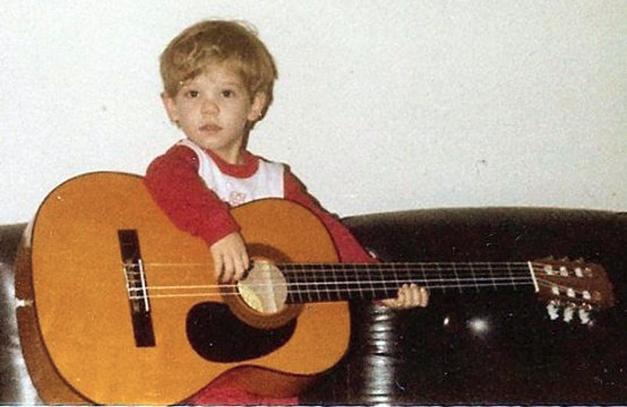
Kevin got the fever at an early age:
“I don’t remember a time when I wasn’t enthralled with the guitar.”
Was there a particular artist or song that really moved your spirit and inspired you to pick up a guitar?
KW: I don’t remember a time I wasn’t enthralled with the guitar. When I was little, our neighbor had guitars and a drum set. We’d go over and I remember just being in awe of everything. The first time I really remember being aware of the guitar making noises that I had to discover the secret to was “Don’t Let Him Go” by REO Speedwagon. I’d jump up and down on the bed and play air guitar singing along to my imaginary crowd. That swell of guitars getting louder and louder, sounding like they’re about to explode… Craziness. I also remember the end credits on Flash Gordon. The song that plays is “The Hero” and Brian and Roger [May and Taylor, respectively, of QUEEN] sound like they’re destroying Tokyo along side Godzilla. Those drums and that bashing guitar riff… I remember wanting to be Queen, whatever that meant to a 4 or 5 year old. By the time I was really playing guitar it was Winger’s Pull album, Extreme’s III Sides To Every Story, and Dream Theater’s Images and Words that were really changing my life.
In fact, Kip Winger has become one of my biggest songwriting heroes. Believe it or not, the song “Weird Days” was hugely influenced by the way he approaches chord changes through sections of a song. I loved Def Leppard so much in the late 80s and early 90s. When Steve Clark died I used to dream of being able to audition to fill his shoes. I was such a fan of his playing, and I just knew as a teenage dreamer that I was the right guy to honor his legacy! On a purely guitar-related front, I’d obviously have to add Joe Satriani, Steve Vai, and Eric Johnson. The late great Gary Moore also taught me nearly everything I know about improvising over blues progressions. I’m pretty sure I wore out 2 cassettes of Still Got The Blues.
I’m totally with you about Steve Clark and Gary Moore. They were two very distinctive, influential guitarists who truly left their mark in the music world and are greatly missed!
Let’s talk now about BIPOLAR ECHO. Are all of you from the same area?
KW: We’re all from the general area, yes. Michael lives in Amarillo (Texas), so we have a 4 hour round trip—either us to Amarillo, or him to Guymon to rehearsal. When we’re on the busy side of gigging, sound checks are rehearsal and writing sessions!
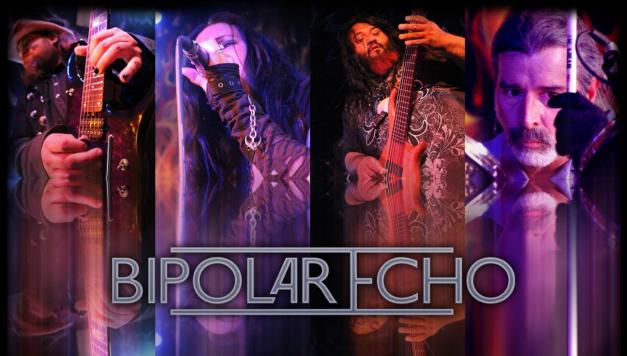
(L/R: Kevin Wale, Amber Fesmire, Ramiro “Tiny” Rosalez, and Michael Kennedy)
How did you get together?
KW: We formed when I was in college. Our original drummer, Brad Duren, was my history professor. His undergraduate degree was in music, and I was majoring in music with a minor in history. So we had a lot in common, including an unexpected love for Uriah Heep. There was going to be a fairly well-known country singer play at the school, and Brad was asked if he could put a band together to open for her. We had been discussing getting together to just jam in the garage, so he asked if I’d be interested in that. Things went from there. I went over to Amber’s office (she also worked at the college) and the three of us started learning Journey tunes and various other radio staples. The partial version of just the three of us blew me away. We sang harmonies like we grew up in the same house together! We didn’t even talk about who would sing what. We just went and poof… we sounded like Queen (laughs). He was this Jeff Porcaro type drummer who also had some hard rock chops—he was like an L.A. session drummer. It was pretty clear early on that we could do anything we wanted if we set our minds to it.
We became BIPOLAR ECHO in April of 2007. It took a while before we crossed over from local cover band to “let’s go get this!”. Ironically, the pressure that “let’s go get this” can create is really when people can stop having fun with it, too.
How long has the band been together in its current lineup?
KW: Jacob left in March or so of 2012. Mike joined in February of 2013. We’ve had this lineup ever since.
Even these days, having a female lead singer isn’t all that common. Did this arrangement come about naturally or was that your initial concept?
KW: It came naturally. Amber had come on board in an earlier band to play keys for the one show we ever played. She and I were sitting in her car, listening to the songs we were going to play and talking about what was doable and whatnot. She would be singing along with the songs and I was like… “WHOA!!!!” After that band fell apart, BIPOLAR ECHO came about when our first drummer approached me about playing a show he had been asked to play. I said, “I have just the singer/keyboard player in mind that we need to talk to!” I went and pretty much told her she was going to be in the band…this time as the primary singer.
Do all of you participate in songwriting?
KW: There are no set rules to how we have to write. Often, I’ll bring in a songwriting demo and we’ll set off to learn it, and through that people will bring other ideas to the table. A cool stop here, let’s try it without the pre-chorus there… and we just feel it out until it makes the most sense. “Sorry For You” was a riff we were all jamming to, and I ended up doing the rest of the demo. Then we got together and things got whittled down and honed in from there. “Barbie Doll” was everyone in a room, and it was mostly done by the end of that night’s rehearsal. Tiny and I changed the bridge a few weeks before we went to the studio.
What topics do you find more prevalent in the lyrics?
KW: Hmm, lyrics. I guess that varies too. Amber wrote the lyrics to “Sorry For You” when someone who worked for her kept whining about life being unfair while they were willingly self destructive to cause all the problems in the first place. She wrote “Barbie Doll” as a response to being patronized. I wrote “Watch Me Fly” as a response to the idea of “that’s good enough” being the root of nearly all the people who actually wish others to fail. However, Amber wrote the “Weird Days” lyrics after watching one of the Terminator movies, and they’re totally unconnected to any real life events (laughs).
When and how did Beau Hill come into the picture? Did he handle all of the production and mixing for your recent EP and singles, or did you do some of this yourself?
KW: Beau heard us back when MySpace was actually a really effective way to promote independent music. We had recorded the EP and it was mixed in-house. I made a little mashup of all the songs into a 2 minute preview and he heard that. So he messaged us and asked if we’d be interested in him doing a mix—which, after we heard his first draft on “Watch Me Fly”, there was no doubt we needed to have him do all the songs! Beau was so creative with the mixes that he essentially co-produced the EP after the fact in a lot of the decisions he made, and some great arranging additions he added.
We did the singles at Bell Labs Recording in Norman, Oklahoma. Trent Bell (you may remember him from the band Chainsaw Kittens) has been engineering all of the Flaming Lips records and he’s brilliant. We’re a complete departure from the kind of music he normally listens to and works on, so there are no rules. We basically produced the singles, but he was such a solid presence that he really did do a lot of producing-type things. As before, Beau was essentially an after-the-fact producer again with some very creative decisions.
He has given some great advice at key intervals that kept us from wasting a lot of time and money. He’s also been great to allow me to pick his brain on my quest to become a better producer and mixer myself. It’s pretty neat to work with a guy who produced and mixed some of my all-time favorite guitar players in Gary Moore, Reb Beach and Kee Marcello… It makes me nervous to send him my solos, that’s for sure!

I’ve been listening to your EP Weird Days lately and I like what I’m hearing. The riffing has a modern feel to it, but your solos are very melodic and reminiscent of the music many of us still like so much from the mid-to-late 80’s. For those who haven’t yet heard of BIPOLAR ECHO, why don’t we introduce you properly?
Here’s the video for “What I Thought,” from the EP Weird Days:
I have to say that it’s gratifying as a Midwesterner to know that good Rock & Roll is alive and well in our part of the country. I’m hearing more and more about bands from the Midwest taking the reins themselves and making their presence known. You surely realize, though, that this area is not necessarily notorious for heavy rock so much as it is for the other end of the musical spectrum. Has that helped or hindered the band’s following?
KW: In some ways being in the middle of nowhere helps, because we can travel 6 hours one way to Denver, 6 hours another way to Tulsa, and 8 hours another way to Dallas. But, it also hinders because we can’t just sit in Dallas and play every other night. Moving would cost more of a fortune than traveling does because some of us have families. It’s hard, but I never let myself get mired in complaining. Especially now, we’re all pretty much playing by the same rules, so if someone else has done it… so can we.
Our experience has actually shown that every town is so different that the other end of the spectrum is pretty much irrelevant to us where it affecting our audience is concerned. I think we’re more affected by the fact that clubs that are thought of as music clubs…the clubs where you play 30 to 50 minutes of your own material and not 4 hours of covers with your stuff thrown in…those clubs are so far away from us, and many of them require you to sell tickets. If you’re not from that town, that means you’re paying to play for a while. On those longer shows, you can play 2 or 3 of your own songs in a row and people might not even realize you’re there. They forget until you play whatever song it is that gets that particular place going every time.
Earlier, Kevin, you brought up a very important point in such a profound way. You said, “Ironically, the pressure that ‘let’s go get this’ can create is really when people can stop having fun with it, too.” People who feel a calling start off doing it for the love of it. And you really have to love what you do, because the life of a musician can be a hard one.
I’ve seen a lot of artists content to play the coffee house or the club scene indefinitely. You know, they have more opportunity to bond with the crowd and there is great freedom, ironically enough, in relative anonymity or a local following.
I think that these days, people’s aspirations and intent seem more grounded. They’re not going into this with the naïveté that used to be so prevalent.
On the other hand, there are many who still hold this ideal in their minds that it all has to happen according to a certain formula or schedule, ultimately resulting in mega-stardom and all the trappings and amenities that stereotypically (used to) go along with that. They can become so focused on the end result that they forget about the means to that end, and, like you say, it stops becoming fun and feels more like a job. Do you think that some artists unconsciously create that pressure for themselves?
KW: My experience is that artists don’t create the pressure themselves, but rather tend to not expect that when pursuing success in anything, it takes dedication, focus, and hard work. In our case, I think that pressure didn’t really ever get to anyone; they just realized that other things were more important in light of that pressure. For instance, Brad had a difficult choice between his tenured position as Chair of the History Department at OPSU, and all the years spent working very hard towards that, and putting the same kind of work into building a music career. It is very luring when you’re in a very good band getting write-ups on Roadrunner Records’ page and working with people like Beau Hill. But, in the end, I think he came to the place where he was looking at his kids, his already established career that he also enjoyed, and just felt being in a band with the focus we had wasn’t something he had to have to be happy.
And where is your stance—and the band’s—in all this?
KW: Our only stance is that we feel we’re good enough keep trying, and that if we stay open minded and willing to work hard, any problem can be overcome. With that, pressure is just one of the problems that comes with any goal in life. The famous cliches “If it was easy, everyone would be doing it” and “anything worth doing is worth doing well” are cliches for a reason.
I suppose that the difficulty in the journey means that, when you have families and whatnot, any new level of success can actually be the point to where someone else might need to drop out. It’s very important to note—despite the attitude of many A&R types that if you have a family you don’t want it bad enough—the truth is if musicians were paid like anyone else who performs a service, A&R men wouldn’t be needed. It isn’t some chicken’s way out if the negative money aspects of this business force someone to choose a more conventional life. I know Bob Lefsetz says that no one is owed a music career, and to some extent he is right. BUT, no one should be forced to do slave labor either in order to prove some rite of passage that you want it bad enough. Come hang out with us and see how hard we work and how bad we want it… AND see how difficult decisions have been made in dealing with the pressures, both necessary and trumped up, by a few people who decided to start taking a chance. Everyone will deal with the pressure differently. Brad had something to fall back on that he loved. I don’t really know how to do anything else well, so I can find myself feeling a huge deal of pressure because I don’t feel confident or skilled at much anything else. I loved managing movie theaters, but that doesn’t mean I was very good at it! (laughs) All that being said, everyone on Earth has to overcome pressure and fear of failure in anything they do. This business just presents a few specific challenges that are difficult in a unique way because there aren’t many road maps. Any artist of any discipline, whether it be painting, drawing, acting, music, web design, et cetera, deals with the lack of road map problem. There are so few opportunities to be successful that people aren’t always so willing to take on an apprentice if you will. It’s hard to not feel threatened by other talented people just from an ego perspective. Add the relatively small area of opportunity to that, and you don’t end up with a lot of honest textbooks on building a music career.
Do you feel that the changing times have taken away from or added more options for artists?
KW: I feel they have done both. Just like an unexpected opportunity to work with Beau Hill. If we were in this position 20 years ago, we’d be signed, on the road in support of an album, with a per diem and our signing bonuses in the bank. But, 20 years ago, we would have had a much longer road in ever getting Beau’s attention. He didn’t have the avenues to look for undiscovered talent in the same way that talent didn’t have as many avenues to get noticed.
These days with the pros and cons of technology and of course the resulting mass competition out there, even bands that have been around for years may be finding themselves working on other projects to pay the bills as well as expressing their many creative ideas. What are your thoughts? Has this made it easier or more difficult for you as a band?
KW: I wish I knew how to feel about it, and how to think about it. In some ways, there are no boundaries. Just like the competition you mentioned. We musicians have the weirdest kind of competition. [It] helps you grow, but we’re at our best when we’re helping each other out-climb us. The difficulties as a band come from the usual things. Most independent bands barely get paid, and even have to pay to play shows. The people with the power to expose want free labor in most cases. I suppose this may not endear me to many, and I know some of them are as trapped by the system as we are, but the decline in sales has made it to where no one wants to take chances. You can’t get a manager who can really help you in most cases unless you’re making money, because they know that without having traction radio isn’t going to play you—and booking agents aren’t going to have anything to work with either. Def Leppard [for instance] didn’t have that dilemma. All they needed to knock Peter Mensch’s socks off was to be their awesome selves. It’s hard for bands to operate as businesses because… Well, how do you get a business loan when your business model is, “hopefully we’ll last long enough on those pay-to-play shows that merchandise sales will outpace expenses?”. You can’t stay on the road long enough to get traction without money, and so the circle goes. But, obviously, there is still a way.
I am always interested in artists as individuals, beyond the music. I think it helps give readers and fans insight to the essence of what the artists are about. Keeping in mind the topic I mentioned in the prior question, what kinds of things do you do other than or including music to help support your artistry, creativity, and livelihood?
KW: I love the studio, so I try to find my way into little local studios and do session work if I can, or help produce, mix, et cetera. I’m also involved with Crucible Divine (project of BIPOLAR ECHO’s former rhythm guitarist) as a co-writer/arranger. I really only helped arrange songs towards the end of the writing process of the first album and recorded the lead guitar bits, some overdubs, some backing vocals, and some bass guitar. This time I found myself more involved with the writing process when I was lucky enough to hear the rest of one of the songs to which Raymond had a riff.
I also love to draw, paint, and mess with Photoshop and graphic art doodads. I did the EP artwork, and I always find myself messing with the web pages and whatnot.
I am currently working for a music store as the Road Sales Rep to the school music departments in the area. I wish I was creating music full time, but it’s nice still being able to be around music, and to use my knowledge in those areas too.
What sort of musical direction do you envision for the band? Do you feel you all have achieved that, or will there be more surprises in the future?
KW: I feel we have achieved a great direction thus far for sure. I don’t really know of anyone who sounds like us, and I think we have a great mix of modern pop and the musician nerd side that raises an eyebrow here or there! We’re always trying to think in terms of better and more interesting hooks and stronger songs. I don’t know if there would be too many surprises as the format is pretty standard in a lot of ways: loud guitars, over the top loud vocals, big drums, and thundering bass.
I guess, at least speaking for myself, I just envision us hopefully getting better and more efficient and seeing what comes out.
I understand that you are currently putting together a solo project. Are you then handling all aspects of it in terms of writing, music, vocals, and production?
KW: It’s still early enough that I’m the only one involved. I’m undecided on how to handle all of the vocals, or even what to call it. Is it Kevin Wale, or is it some cool name like Ayreon for Arjen Lucassen?
Money is always the biggest hindrance in how some of those things are handled. I’d love to have Trent and Beau both involved, but we’ll have to see.
Here’s a sample of what Kevin has been up to lately:
https://soundcloud.com/kevin-wale/under-cover-preview-1
When might we expect to hear more from Kevin Wale and Bipolar Echo?
KW: We’re hoping to hit the studio with a whole set of new songs early next year. We have 9 or 10 at this point, so we’ll be able to decide if we should do an album or keep going the singles route, which is becoming more and more common in this mp3 driven world we live in. We’re hoping to get a Pledge Music campaign going for that soon.
I hope to have enough songs written to get a feel for how I should proceed by the end of the summer. I might actually be the Guinea Pig on Pledge Music before the band dives into that!
Kevin, I really enjoyed getting to talk with you and hearing your thoughts about so much of what goes on in the life of a musician. Thanks so much for your time! Please keep us posted at Metal Shock Finland with any news or new music you put together. Every best wish to you and the band for growing success and happiness.
Links:
http://www.bipolarecho.com/
http://www.facebook.com/bipolarecho
http://itunes.apple.com/us/artist/bipolar-echo/id388851027
http://www.youtube.com/channel/UCQJmetn6JzIU6Wet60C0Ftg


 Click image to watch the video


 Metal Shock Finland (World Assault )