
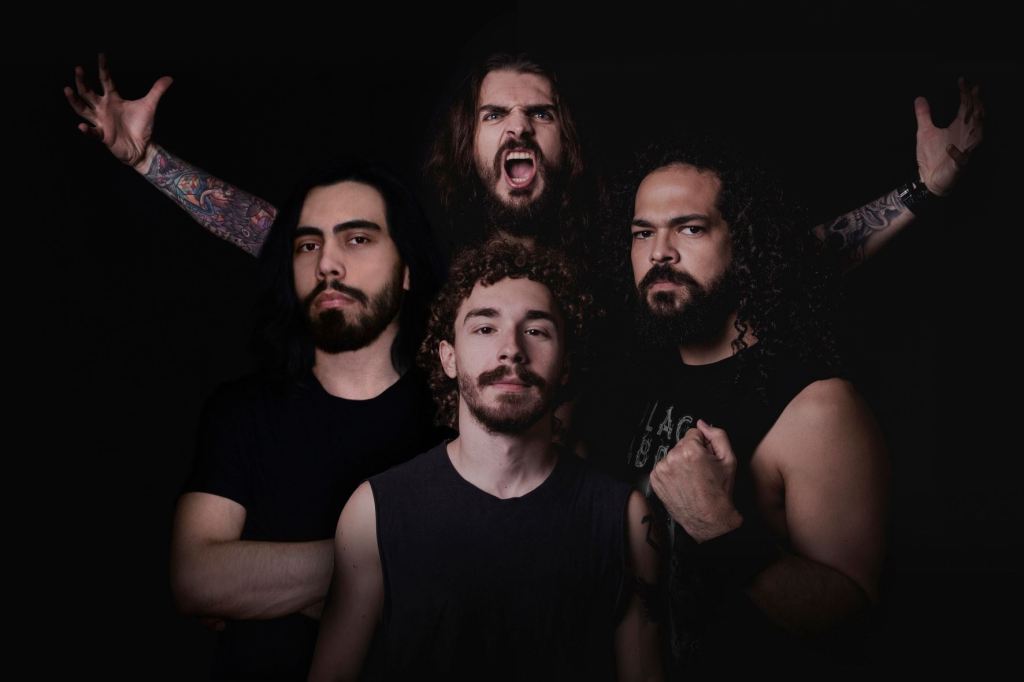
Brazilian Heavy/Thrash Metallers, appropriately called Neo-Thrashers, of VALVERA have launched their fantastic and scary new music video for its song “The Damn Colony” on the band’s official Youtube channel. This frightener video reachead the incredible milestone of over 10.000 views and it keeps increasing day by day!
“We are very happy with all the repercussion of the video, since we knew from the beginning that we had an excellent script, a brilliant technical team and actors guiding us. Thank you very much to everyone who watched, liked, commented and mainly subscribed to our channel, because that positive energy is what feeds us”, commented Glauber Barreto
“The Damn Colony”, a track featured in the band’s acclaimed and praised work, “Cycle Of Disaster”, which had its video pre-released two days earlier in partnership with Metal Hammer Portugal, is a track based on the horrendous history of Hospital Colonia Barbacena, in Minas Gerais. Founded in 1903 and with a capacity of 200 beds, the hospital had an average of 5,000 thousand patients in 1961 and became known for the mass genocide that occurred especially between the 60s and 80s. Trains with full wagons (called “crazy trains”), similar to those in German concentration camps, dumped” human waste “for” treatment “at the hospital daily.
Watch “The Damn Colony” here:
Direction and Photography: Plínio Scambora (@plinioscambora)
Art Direction/General Production: Raquel Tejada (@quel_tejada)
Production Assistants: Aline Lopes (@a_linelopes) and Rennan Carlos (@ rcarlos.arch)
Set production: Matheus Sabino (@sabinofilmes)
Making Of Still: Fabrício Silva (@fabricioluizs)
Makeup: Fabrícia Rodrigues
Actors: Carla Costa (@ carla.csta), Pedro Pellegrino (@pellegrinopedro) and Jaque Rofer (@jaquerofer)
Figuration: Eluizio Felix (@eluiziofelix), Raquel Ferreira, Maria Luciene Oliveira, Rose Pereira, Sergio Machado (@ _sergio.machado_), Bárbaro Xavier (@barbaroxavier), Karla Camioli (@karlacamioli), Carla Gobato (@cacagobato), Sebastião Vieira and Matheus Aiello (@ aiello.mclion)
“It is a really horrendous, sinister and even unbelievable history to believe in. In this hospital, people’s clothes were stripped, their hair shaved and their names erased. Naked in body and identity, kidnapped humanity, men, women and even children ate rats and feces, drank sewage or urine, slept on grass, were beaten and raped to death” commented Gabriel Prado.
It is estimated that about 70% of the inmates had no diagnosis of mental illness. The hospital was intended to contain the undesirable, with the function of cleaning and sanitation in the locality, in the words, “unpleasant and uncomfortable people” for someone with more power, such as political opponents, prostitutes, homosexuals, beggars, people without documents, epileptics , alcoholics, pregnant girls and raped by their bosses, wives confined so that the husband could live with his mistress, daughters of farmers who lost their virginity before marriage, among other marginalized groups in society.
“The Colonia Hospital’s patients died of cold, hunger, disease. They also died of electroshock. In a few days, the electroshocks were so many and so strong that the overload knocked down the city’s network. In periods of greater capacity, 16 people died each between 1969 and 1980, more than 1,800 bodies of patients were sold to 17 medical colleges in the country, without anyone questioning. When there was an excess of corpses and the market shrank, the bodies began to to be decomposed in acid, in the Colonia Hospital, in front of the patients still alive, so that the bones could be commercialized”, commented Rodrigo Torres.
The Italian psychiatrist Franco Basaglia, a pioneer in the anti-asylum struggle in Italy, was in Brazil and met Colonia in 1979. At the time, he called a press conference and vented: “I was in a Nazi concentration camp today. Nowhere in the world, I witnessed a tragedy like that.”
“The exorbitant and silenced numbers (for more than 50 years) of summary, cold and violent executions that took place at the Colonia de Barbacena hospital far outweigh the deaths registered and hidden in the Brazilian military dictatorship (among Indians, peasants, persecuted politicians, etc. They surpass even the numbers of the bloodiest dictatorships in Latin America, Chile with more than 40 thousand and Argentina with more than 30 thousand dead”, commented Glauber Barreto.
“As artists that we are, we have an obligation to speak, to be the voice of the people, to bring questions and answers so that things like this never happen again”, concluded Leandro Peixoto.


 Click image to watch the video


 Metal Shock Finland (World Assault )