
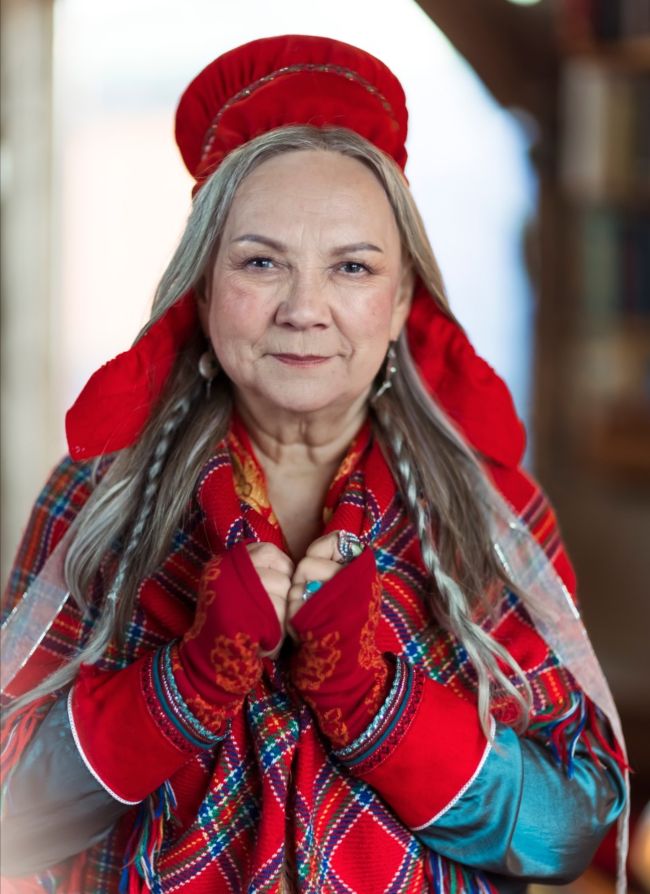
Photo by Astrid Waller
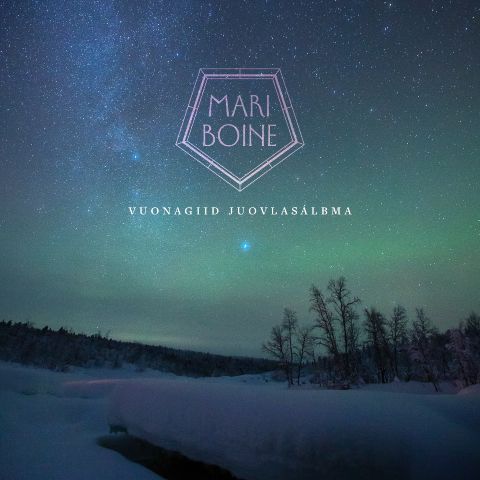
Acclaimed singer, musician, activist, and cultural icon Mari Boine first took part in a Christmas project early in her career, back in 1987. Now, almost 40 years later, she returns with the same spirit with the release of her timeless single “Vuonagiid Juovlasálbma” (Nordnorsk Julesalme).
One of Norway’s most beloved Christmas songs, “Vuonagiid Juovlasálbma” is now reborn in Sámi, Boine’s heart language. The Sámi translation by Isak Samuel Hætta inspired her deeply, carrying a spiritual bond to nature (luondu) that continues to resonate through her music.
Boine’s new interpretation blends cultural heritage and emotion, celebrating the enduring connection between language, land, and song.
Listen to “Vuonagiid juovlasálbma” HERE
Mari comments: “For a long time, I have wanted to bring Nordnorsk Julesalme – a song already performed beautifully by many – into Sámi, my heart language.
I envisioned a quiet, meditative version – like skábma, the long winter darkness before Christmas and the Solstice – a time when we slow down, look inward, summon gratitude, and draw close to those we love.
When I first heard Isak Samuel Hætta’s Sámi translation, Vuonagiid Juovlasálbma, I was deeply moved. His poetry carries a spiritual bond to the land and to nature (luondu), a connection that has also shaped Trygve Hoff and me. That is the feeling I have tried to bring into this version. Around it, Stein Austrud has painted a musical landscape that is luminous — like light moving across snow”, says Mari Boine.”
Credits “Vuonagiid Juovlasálbma”/ Nordnorsk Julesalme
Lyrics/ Sanít: Trygve Hoff, Isak Samuel Heatta
Arranged & produced by Stein Austrud
Featuring artist: Stein Austrud
Composer: Trygve Hoff
Piano, strings, percussion & soundscapes: Stein Austrud
Mari Boine – Vocals
Mari Boine live:
26-FEB-2026 Konzerthaus Dortmund (DE)
27-FEB-2026 Berliner Philharmoniker Berlin (DE)
28-FEB-2026 Elbphilharmonie Hamburg (DE)
01-MAR-2026 Theater Putbus (DE)
Mari Boine
Almost forty years have passed since Mari Boine first captivated audiences around the world. Her groundbreaking album Gula Gula, released internationally on Peter Gabriel’s Real World label, introduced a powerful new voice in global music. That same year, she collaborated with Roger Ludvigsen on the acclaimed album and BBC TV documentary One World One Voice, directed by Kevin Godley with musical direction by Rupert Hine.
With her unmistakable voice and in partnership with Ludvigsen, Mari developed a sound universe entirely her own. Gula Gula earned her the first of four Spellemannprisen awards (Norway’s equivalent of the Grammy). Over the years, she has also been honoured with the Nordic Council Music Prize and the Arts Council Norway Honorary Award.
In 2009, she was appointed Knight First Class of the Order of St. Olav by the Royal Court of Norway — the country’s highest civilian honour. She has also received a Lifetime Achievement Award (Spellemann 2018), the Sámi Council’s Honorary Award (1992), and a government grant recognising her contribution to preserving and promoting Sámi culture.
From the very beginning, Mari Boine has been one of the most important and outspoken advocates for Sámi identity and culture. Through her music and activism, she has inspired generations to embrace their heritage and take pride in their roots.
Throughout her career, Mari has toured extensively across the globe — from South Africa to Asia, from North America to Europe — and shared stages with artists such as Jan Garbarek and Bugge Wesseltoft. She has also contributed to several film soundtracks, including The Kautokeino Rebellion (Nils Gaup, 2008), Burning (Hallvard Bræin (2014), The Miracle of the Little Prince (Marjoleine Boonstra, 2018), and Hänsel and Gretel (Anne Wild, 2006), a Grimm Brothers classic frequently broadcast on German television.
Mari Boine has released sixteen albums worldwide. In 2024, she unveiled Alva — an album that re-centres her lifelong activism through deeply personal reflection. Returning to her Sámi roots, she revisits the emotional landscapes of her childhood, family relationships, and journey toward self-liberation. With a title meaning “energy” or “willpower” in Northern Sámi, Alva blends powerful joik vocals with rich band arrangements, offering a resonant portrait of resilience, heritage, and healing. It stands as one of her most intimate and dynamic works to date.
Following her appearance on the TV series Every Time We Meet (2024), alongside other renowned Norwegian artists, Mari’s music reached an even wider audience, and her following grew significantly.
Mari Boine will turn seventy in 2026 — a perfect moment to celebrate her life and legacy. Plans are underway for a commemorative TV documentary to be broadcast in Norway, Sweden, and Finland, and a celebratory concert with special guests will take place on her birthday, November 8th, in Oslo.
She will also tour extensively in 2026, including performances with her band at the Berlin Philharmonie, Elbphilharmonie (Hamburg), and Konzerthaus (Dortmund) in February.
Currently — until early April 2026 — Mari Boine’s music can be heard at Tate Modern in London, where the work of Sámi artist Máret Ánne Sara occupies the museum’s prestigious Turbine Hall.
What more could complete the accomplishments of an artist?
Mari Boine reflects with a smile: “If I could compose my own life, I would have wanted to be who I am now — only forty years earlier.” She laughs softly, aware of the impossibility. “Right now, I feel whole,” she says. “As complete as I have always wanted to be.”


 Click image to watch the video


 Metal Shock Finland (World Assault )