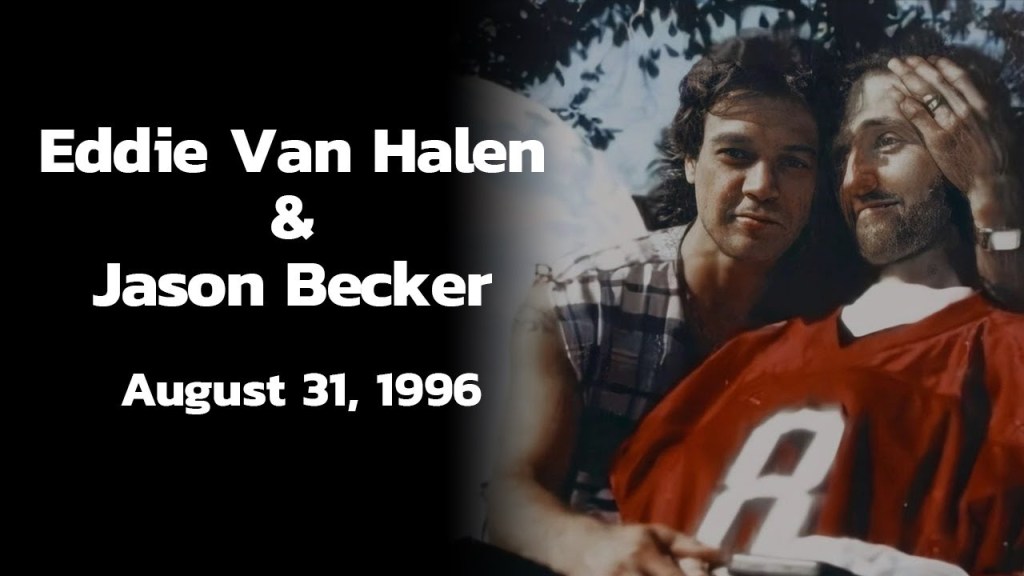
An amazing meeting took place on August 31, 1996. That’s when Eddie Van Halen spent the day with a guy who had followed in his footsteps playing alongside David Lee Roth—Jason Becker. Jason hadbeendiagnosed with ALS, or Lou Gehrig’s Disease, and was not in good shape. Van Halen came to Jason’s house to give love and support—as well as a guitar—to his friend and to film an ALS awareness promotional video. During that time, Eddie told stories, talked about his creative process, and played amazing music, instantly sounding exactly like Eddie Van Halen even when playing Jason’s guitar through a small practice amp.
This never-before-seen footage shows a side of Eddie Van Halen that goes far beyond his brilliant musicianship: a sweet, caring, generous personality, devoid of the trappings of fame or rock stardom. The video also documents the incredible strength of Jason Becker, who had been deprived of his shot at fame as well as his genius guitar skills, but still found the courage and the will to battle a debilitating disease.
“Eddie was such a beautiful person,” says Becker. “He was incredibly kind to me and my family. Not only was he my biggest influence, he had such a huge heart. He honestly saved my life.”
This video is a must-see piece of history, not just for guitarists but for everyone. It truly shows the magic of kindness, and a depth of emotion that we can all use more of.
Brazilian heavy metallers RAGE IN MY EYES drummer Francis Cassol dedicates his performance of ‘Jump’ to the great Eddie Van Halen!
Francis stated: “I recorded this video before EVH passed. It was not intended to be a tribute, but I humbly would like to dedicate my performance here to the great EVH. Its always fun to play VH, because Alex has a unique approach to the drums, in a way only he can do. And it sounds SO GOOD playing Van Halen on my 2002s @paistecymbals! Hope you all enjoy my performance to this classic: JUMP! 🤟 #vanhalen #jump #drumcover”
Just previously RAGE IN MY EYES released the new cover video for ENGENHEIROS DO HAWAII‘s “A Perigo/In Danger” (C) 1996 Bmg Brasil, watch it here: https://youtu.be/izPJmCk4I58
And after participating in Bode Metal Fest and the live commemorative of one year of the show with Iron Maiden, RAGE IN MY EYES are preparing to participate in other online events, to be released soon.
In case you missed the special live chat remembering the show with IRON MAIDEN, held one year ago, watch it here: https://youtu.be/uATGCICNWIY. Also watch the video clip for ′′Hole in the Shell”, which contains some scenes recorded by fans themselves at the opening for Iron Maiden and it was produced by Marcelo Melo Pereira. Watch the video here: https://youtu.be/qUAd5CRGUpY
Earlier this Summer, RAGE IN MY EYES released the lyric video, created with fan photos/footage, for an unreleased song “I Don’t Want to Say Goodbye”, as a tribute in honor of the late vocalist, ANDRE MATOS. Now the tribute is available on digital platforms. Watch the lyric video “I Don’t Want to Say Goodbye” here: https://youtu.be/ozatlPc-66k or stream it on Spotify: https://open.spotify.com/album/5DbuESXnyaiHiR90Ek5skb
——————
RAGE IN MY EYES are blending heavy/prog metal with elements of milonga (a music genre from southern Brazil, Uruguay and Argentina), the band presents a never-heard metal before.
RAGE IN MY EYES is a heavy metal band from Brazil. For 17 years the band went under the name SCELERATA, that had a huge history in the Brazilian heavy metal scenario. The band had three albums released worldwide, including the acclaimed album “The Sniper”, feat. guest appearances from Paul DiAnno (former Iron Maiden) and Andi Deris (Helloween). Scelerata was also Paul DiAnno’s official Brazilian backing band from 2009 to 2014, playing 50+ shows with this heavy metal icon. On October 9th, 2019, RAGE IN MY EYES joined IRON MAIDEN in Porto Alegre, Brazil, at Gremio Stadium. With this huge background, the musicians are now aiming for the future.
RAGE IN MY EYES’ latest album, entitled “Ice Cell”, is available on all digital platforms. The album was recorded between 2017 and 2018 in the cities of Los Angeles (USA) and Porto Alegre (Brazil) and was produced by Magnus Wichmann at Magneto Studio (Brazil) and Daufembach Studio (USA). It was mixed and mastered in Los Angeles by the renowned Brazilian producer Adair Daufembach. The cover was designed by Tiago Masseti, who has worked with Hibria, Luis Kalil and Daydream XI. According to the band, the graphic art seeks to show the mascot Sage in a darker mood: “We wanted to present a more realistic Sage, with a strong expression and at the same time that seemed marked by life; we brought him closer to us.”
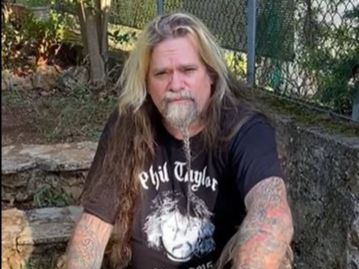
Jimmy Kay and Alan Dixon, from The Metal Voice, talk to Former W.A.S.P. guitarist Chris Holmes about him growing up with Eddie Van Halen in California, watch below.
Join Jimmy Kay, Alan Dixon and special guest Aldo Nova as the pay tribute to legendary guitarist Eddie Van Halen. Aldo Nova gives his perspective on Eddie Van Halen as a guitarist, composer and his legacy. The Metal Voice
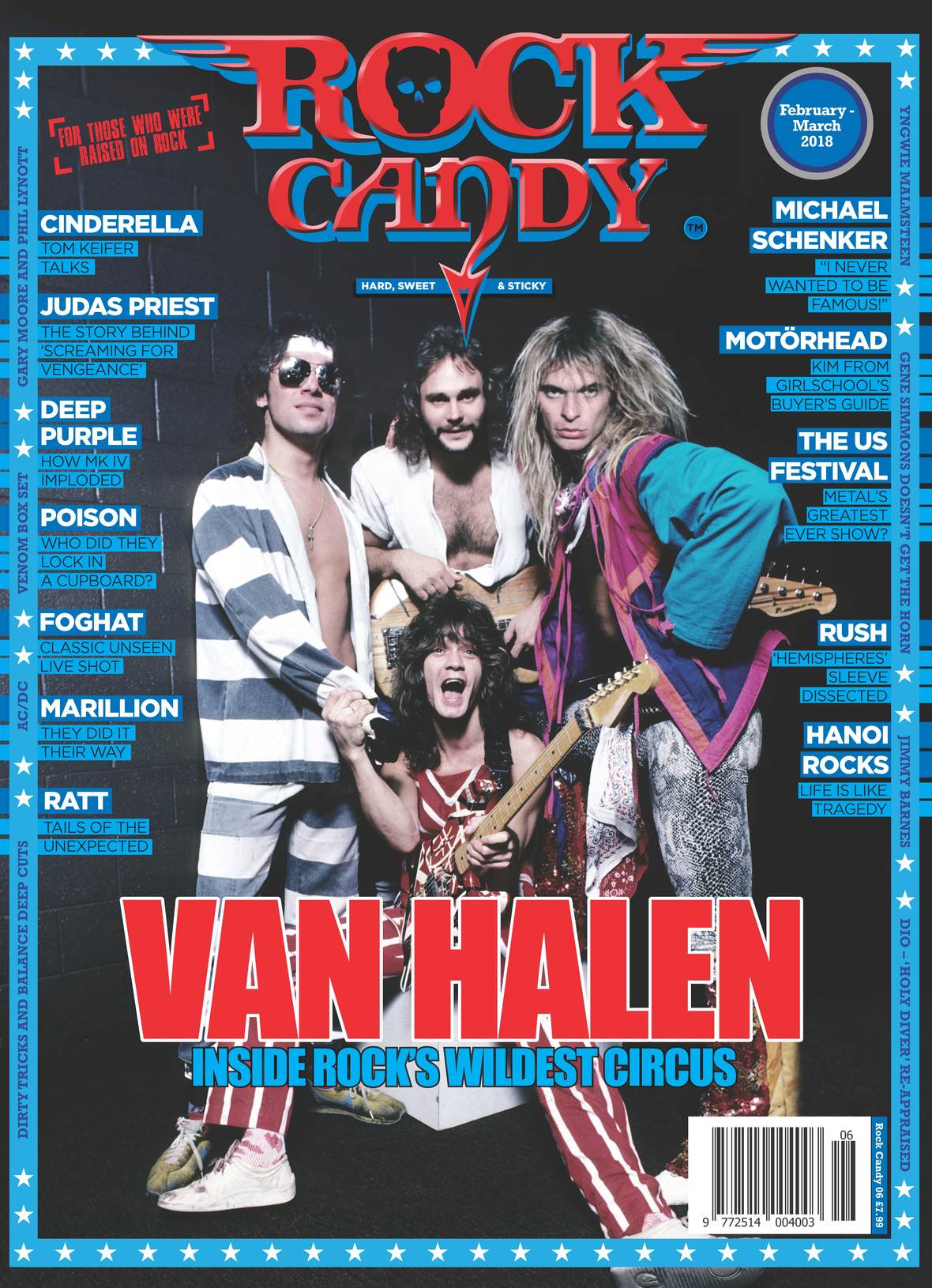
Issue #6 of the UK based Rock Candy Magazine features an exclusive candid interview with legendary rock guitarist Steve Vai. Vai may be an acknowledged guitar genius himself, but the man who has received so many plaudits himself is convinced that it was only Eddie Van Halen and Jimi Hendrix who fundamentally changed the shape of rock music.
Exclusive Issue #6 Steve Vai article preview:
Speaking exclusively about his deep appreciation of Edward Van Halen in the new issue of Rock Candy magazine, Vai told editor Howard Johnson, “There are so many guitar heroes I love, and maybe even prefer over Edward in a sense. But the two guitar players who really created a paradigm shift in my opinion were Jimi Hendrix and Edward Van Halen. Everybody else has contributed wonderfully to the art form. But when you look at scope of their individual contributions and how they became pivotal turning points for guitar playing, those two guys were the most effective.”
In a wide-ranging interview all about the Van Halen legend that forms part of Rock Candy mag’s 14 page VH feature in the current issue, Vai recalls hearing Edward’s playing for the first time when he was a student at Berklee College of Music in Boston in the late ‘70s.
“’You Really Got Me’ came on the radio, with the ‘Eruption’ solo tagged on at the start,” he explained. “We were just all completely stunned.”
In a long and illustrious career, Steve Vai has produced some of the most loved guitar music ever recorded, while also bringing his outstanding combination of flash and technique to some of rock’s greatest acts, including Whitesnake and, of course, David Lee Roth. Between 1985 and 1989 Vai performed a number of Edward’s songs alongside the former Van Halen frontman during the height of Roth’s solo career.
“Playing Van Halen songs is such a hoot,” he told Rock Candy. “Especially when you’ve got David Lee Roth singing them! ‘Panama’ is just great. ‘Unchained’ and ‘Ain’t Talkin’ ‘Bout Love’ too. We’d play a whole lot of Van Halen tunes and they were always wonderful. The parts were constructed perfectly, because Edward has real completeness as a guitar player.”
Read the whole of this revealing article, and many more fascinating features, in Issue 6 of Rock Candy Mag, available in shops worldwide and direct from us online only at the following link: https://www.rockcandymag.com/
Rock legend Eddie Van Halen didn’t set out to change the way the guitar was played. But, as he explained to a standing-room-only crowd at the Smithsonian’s National Museum of American History, music shaped his life—and his life shaped his music—in unexpected ways from his very first performances. You can read the background story below, written by Sarah Rothbard and reported by the Van Halen News Desk, and see the full chat on the video.
Van Halen’s father Dutch father was a classical musician who “traveled the world making music,” said Van Halen. He met Van Halen’s Indonesian mother while performing in her home country just after World War II. They got married and moved to Holland, where “life became a little rough.” Van Halen’s mother was a second-class citizen; she was stuck at home with “two rugrats” (Eddie and his brother, Alex) while her husband was away gigging for weeks at a time. So they decided to pack up the family and move to California—to “Beverly” (“it wasn’t Beverly Hills then”), said Van Halen.
En route to America by boat, Van Halen’s father performed with the on-board band during the nine-day journey. After their father suggested that his sons play during intermission, Eddie and Alex learned performance came with perks: The next night, they were eating dinner at the captain’s table.
In Southern California, Van Halen’s mother worked as a maid, and his father pursued music while working as a janitor. The family lived in one room in a house they shared with two other families. In a new country, speaking a new language, the one constant thread was music. “We always liked things loud,” said Van Halen. Nonetheless, he and his brother spent years playing classical piano—despite the fact that Eddie never learned how to read music.
Once the Van Halen brothers discovered rock ’n’ roll, they quit piano lessons. Eddie got a drum set, which his brother coveted.
“I never wanted to play guitar,” he said. But his brother was good at the drums, so Eddie gave into his brother’s wishes: “I said, ‘Go ahead, take my drums. I’ll play your damn guitar.’”
Music journalist Denise Quan, the evening’s moderator, then asked Van Halen to fast forward to 1978. That year, his band’s self-titled debut album hit stores—and turned the music industry on its head. Van Halen was making sounds “that no one had heard before,” said Quan.
In between taking up guitar and becoming a star, there were “a lot of years of experimentation,” said Van Halen—taking apart guitars, opening up amplifiers, and getting electrocuted. Some of that was driven by necessity. But a lot of it was just his nature. “I’m always pushing things past where [they’re] supposed to be,” he said. “When Spinal Tap was going to 11, I was going to 15.”
Van Halen knew the sound he wanted to achieve, but he couldn’t find a guitar that could make it. So he got different parts from different guitar-makers, including Gibson and Fender, screwed and soldered and melted them together, and built the instrument he wanted. (He has a graveyard of vintage guitars he destroyed for their choice pieces.)
Even the instrument’s paint job was unplanned: Van Halen painted the guitar black, but “it looked kind of boring,” he said. There was tape lying around, so he taped up the guitar, spray-painted it white, then removed the tape—and a new kind of guitar graphic design was born.
“Crossing a Gibson with a Fender was necessity,” said Van Halen. The paint job was not.
He customized his amplifier with the same combination of trial and error, tinkering and luck. He purchased a Marshall amp (the brand that “Eric Clapton and gods” used), not realizing it came from England and was 220 volts. He plugged it in—and heard nothing. But after warming the amp up to half voltage, Van Halen managed to get an “incredible” sound from it. The only problem: The sound was so quiet that only the guitarist and his dog could hear the music. Van Halen’s solution was to buy what was essentially a light dimmer at a local electronics store that allowed him to control the volume.
Van Halen’s innovation isn’t limited to his equipment. Quan noted that he pioneered the art of playing with both his right and left hands on the guitar’s frets. Grabbing a guitar, Van Halen talked about finding inspiration at a Led Zeppelin concert at the Forum in Inglewood, California. After seeing Jimmy Page play a lick with one hand on the guitar and the other raised up in the air, Van Halen decided to try placing his second hand on the frets as well. He played a few of the melodies that resulted to loud hoots from the audience.
The main reason he squeezed so many techniques out of the guitar was also “out of necessity,” said Van Halen. He couldn’t afford a wah-wah pedal, a fuzzbox, or other gear that created the processed sounds he sought. He had to rely on his fingers alone.
What advice, asked Quan, did your father give you that you wanted to pass on to your son, who is also a musician?
“You can learn from everybody,” said Van Halen—what to do and what not to do. Especially the latter. “If you make a mistake, do it twice, and smile,” he explained. That way, people will think you mean it. He shared a Dutch phrase of his father’s that translates into, “Just keep pedaling.”
In the question-and-answer session, a young audience member asked Van Halen to describe his first day of school in America.
“It was absolutely frightening!” said Van Halen. The school he and his brother attended was segregated. As non-English speakers, they were considered a minority. The white kids bullied them—tearing up their homework—and so their first friends were the black kids who stuck up for them.
If you were an unknown today, asked another audience member, how would you get your start in a very different music business?
Van Halen told him that things weren’t that different today. Then, as now, rock ’n’ roll was not nearly as popular as other genres. (Disco and funk reigned then, much like pop and hip hop today.) “For a good seven years, we knocked on everybody’s door” because nobody knew who Van Halen was, he explained. They made demo tapes. They played backyard parties. They photocopied their own flyers.
“We just humped it and humped it until people came,” he said. “I don’t see how that wouldn’t work today. Whatever music is out there, there’s always room for more.”
Photo by Abram Eric Landes.
Chief Shock Video
Kimmo Kuusniemi’s ASA unveil the long-overdue release of "Collective Failure" + first music video for title-track! Check it out and stay tuned for more news! Click image to watch the video
Kimmo Kuusniemi’s SARCOFAGUS return with a Historic 2010 Concert Video Premiere on YouTube! Click image to watch the video
Ads
Visionary artist KIMMO KUUSNIEMI's ANCIENT STREAMING ASSEMBLY (ASA) have released “Aurora Nuclearis”, a powerful 12-minute audiovisual experience, dedicated to the Late Keyboardist Esa Kotilainen. - Click image to watch the video





 Click image to watch the video


 Metal Shock Finland (World Assault )