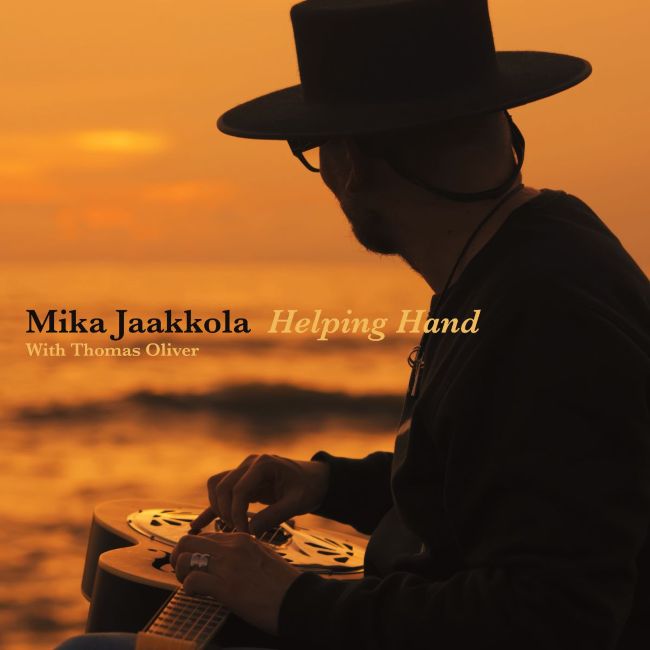
Finnish lap steel guitarist Mika Jaakkola has released a brand-new double single titled “Helping Hand“, created in collaboration with award-winning Weissenborn and lap steel guitarist Thomas Oliver, widely regarded as one of the finest players in the world. Oliver originally joined the project as a producer, but ultimately also became a featured performer on the recording, making this Jaakkola’s first major international release. The double single arrives alongside an official music video for the title track “Helping Hand.”
Behind the release lies a deeply personal story. Nearly two decades ago, Jaakkola lost his ability to play guitar after being diagnosed with focal dystonia, a neurological condition affecting fine motor control. At the time, the hope of returning to music came through slide instruments such as lap steel. During that period, Jaakkola discovered the work of Thomas Oliver while researching and immersing himself in the world of slide guitar.
Jaakkola’s discography already includes collaborations with several prominent Finnish artists, including Marko Hietala (Nightwish, Tarot), Olli Haavisto (J. Karjalainen, Kari Tapio), Janne Haavisto (J. Karjalainen), Timo Kämäräinen (Olavi Uusivirta, Ellips), and Janne Tolsa (Tarot, Turmion Kätilöt). Using his catalogue as a calling card, he reached out to Thomas Oliver with a question: would he consider producing his next release?
“The answer to my humble request was: ‘Would you like to do the recording remotely or come to my studio in Bali?’”, Jaakkola recalls: “My response was obvious and immediate.”
The songs were recorded at Oliver’s studio in Bali, with a clear focus on authenticity: organic production, genuine tone, and a natural dialogue between two guitars.
“Weissenborn players like Thomas Oliver rely on extremely clear articulation and producing a ‘perfect’ sound,” Jaakkola explains. “For me, it was a leap into something new. With focal dystonia in the background, that’s a major challenge. But the acoustic slide guitar tone achieved through this technique is unbelievably beautiful.”
However, the sessions took an unexpected turn when focal dystonia returned at the worst possible moment. A creative solution was found – one that ultimately shaped the identity of the entire release.
Around the fifth studio day, my left hand started cramping so badly that muting the strings became almost impossible. Thomas came up with an idea – he moved his own hand along the fretboard in sync with mine so we could record the parts in real time. For the rest of the sessions there were literally two hands on the guitar neck. That’s where the title Helping Hand came from. We had tons of material to record, but we chose to focus on simple things: the strongest qualities of acoustic slide guitar and the dialogue between two instruments. We succeeded unbelievably well. I’ve never achieved an acoustic guitar sound this good before.”
“This is my first international collaboration and doing it with one of the world’s most respected players of the scene feels unreal. Twenty years ago, after my diagnosis, I thought my career as a musician was over. Back then I listened to Thomas’ music and held on to a small spark of hope that I might one day play slide guitar again. Now the world has turned completely upside down – in the best possible way.”


 Click image to watch the video


 Metal Shock Finland (World Assault )