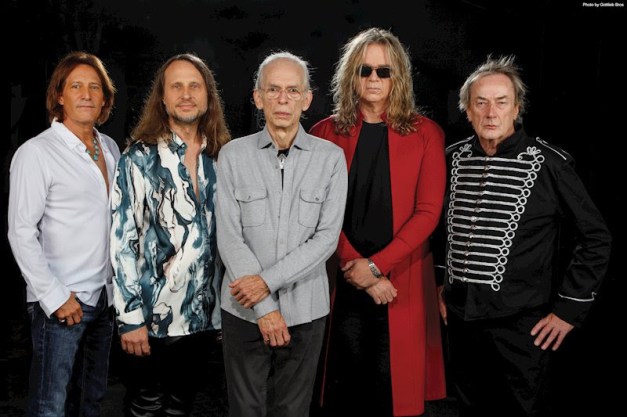
The Metal Voice recently interview Yes, Asia and The Buggles Keyboardist Geoff Downes. He spoke about his career in The Buggles, Asia and Yes. As well as the new Yes Album AURORA which will be released on June 12 , 2026 via Century Media.
Watch the full interview below.
Excerpt
When asked when YES is planning on retiring
“I ask myself that sometimes. We’re still doing maybe four or five shows a week you know and then we come off the road and then we go straight in the studio and start recording stuff. I think it’s a way of life and I certainly don’t think your age is necessary as long as you’re healthy uh and fit and healthy then I don’t think it’s too much of a challenge to keep it going. “
When asked how he revolutionized the keyboard sound back in the early 80s
“I think we were pretty much ahead of the game in terms of what we were doing because the Buggles was in many ways a very prophetic band. The things that we were doing this whole thing about creating these keyboard orchestras, which was really my fortune. We weren’t pretending to be a band or anything like that. We were just two guys experimenting in the studio, hence the name THE BUGGLES, which is effectively a spoof on The Beatles because we knew we’d never be a band. It was only two guys pretending to make all these sounds. Um, so the actual thing that came across was that it was a group effort, but in fact it was just Trevor and myself creating all these weird weird and wonderful sounds. So I really got into technology and I would get as much as I could. I wanted to make noises like strings and you know woodwinds and flutes and things like that but all created via um uh synthesizers. So uh that I think that was something that really appealed to me. “
When asked If he thought ‘Video Killed the Radio Star’ (the song) if it still has meaning today with technology changing the social norms?
“Well that was the whole thing behind it because that had very futuristic lyrics and turned out to be very prophetic. When you take one of the lines from video killed the radio star, ‘they took the credit for your second symphony rewritten by machine with new technology. You’re thinking about AI now and you’re thinking about uh that was that we wrote that song 50 years ago, this sort of this sort of stuff actually happens. We had a lot of fun making these predictions. I think that’s the whole essence of the Buggles and I think that’s one of the things that really captivated Chris (Squire) Steve (Howe) Alan (White) to us because we were going to bring something different to Yes.”
When asked how they joined Yes on the Drama album
“For us it wasn’t that strange that we joined because we were in the next rehearsal room. They were just a three-piece at that time rehearsing Chris Steven Alan. So, Chris came in one day and he said, have you guys got any songs? You know, any material? So, we said, well, we can probably knock up a couple of things. So he said, “Well, why don’t you come in the studio with us and uh set your keyboard up and Trav you set a mic up and see what comes out of it.” And that was really it. We just sort of morphed into Yes at that point. And uh it was uh it was great times. That album stands up as one of my favorite albums I have been involved in. Largely because it was a big turning point for me particularly being a keyboard player in this huge band you know I mean it’s a sort of dream come true.”
When asked about the split with Jon Anderson and Rick Wakeman
“I think the band just got to a halt, they didn’t get anywhere (musically). So I think they just disbanded at that point. I think Jon obviously went off to do stuff with Vangelis. Um yeah, Rick obviously carried on with his solo stuff. Uh so there were really the three of them holding the baby as it were. We fitted the bill. I mean, don’t get me wrong, there was a certain amount of resentment from certain areas of the Yes fan base because they saw these two interlopers stepping into this the revered rock band that they’ve been following from the very beginning and, you know, 10 12 years later, uh, these these two pop guys come in and, uh, and start to shake up the, uh, shake up the foundations. Also I think Trevor’s lyrics they were much more uh urban much more technological much more modern and I think that helped propel YES into the 80s for the later period of 90125. We weren’t talking about rivers flowing and all that sort of stuff. We were talking about electricity running through pylons and that kind of thing. “
When asked if the Drama tour was too difficult for Trevor in terms of singing the Jon Anderson Material
” I think it was. I think it was tough cuz I think it did push him to the limit. But I think you know under the circumstances he (Trevor Horn) did a great job and uh obviously much easier to sing the Drama material but you know going to some of the more high pitched Yes stuff that Jon Anderson was so well known for was a challenge. We didn’t actually transpose anything at all. I think he actually found a way of singing it and a way of delivering it. Uh, and as I’ve said before, there’s a lot of underestimation, I think, for how important Chris Squire’s vocals were with John Anderson. So, I think between Trevor and Chris, they managed to pull it off in terms of uh you know, because Chris was there cuz Chris was a very identifiable vocal part of Yes’ um stuff. ‘