
Interview & photos by Steve Foglia
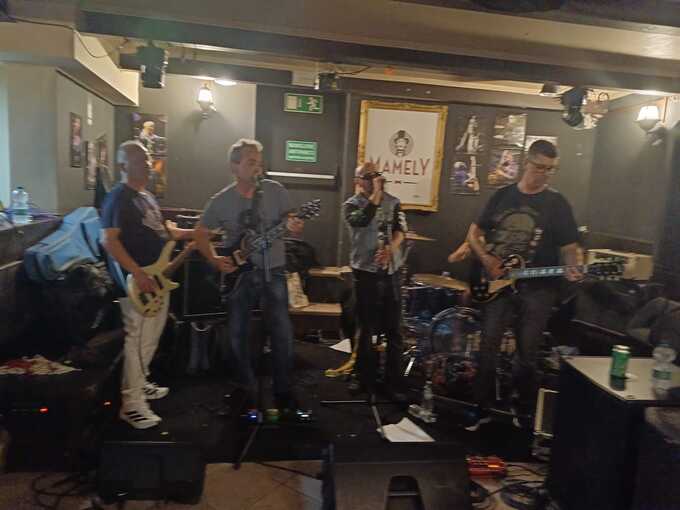
Two-day Scream Rock Fest 2026 took Italy’s City of Flowers, Sanremo by Storm at the end of May, with pure energy dedicated to the best independent and historic bands from the Ligurian and national music scene.
The event’s organizer Steve Foglia conducted an interview with Ligurian legendary hard rockers HOLLYWOOD HEARTBREAKERS (formed in 1989), join the chat below.
- Guys, welcome to Metal Shock Finland! Let’s take a brutal leap back in time: it’s 1989, Daniele is only 15, and you decide to form a hard rock band in Taggia called the Hollywood Heartbreakers. How crazy was it, back then, to try and bring the wild spirit of the Sunset Strip into the narrow alleys (caruggi) of Liguria? What was the vibe like?
Well, this great question already contains the answer within itself. It’s hard to explain the atmosphere of those days to people today, now that we have all the information possible thanks to the internet and so on. Of course, we have to remember that in those years, this kind of hard rock music was absolutely mainstream almost worldwide. It was heavily present in the charts, on the radio, and on TV—it was definitely living its golden years. Despite that, it was almost crazy to think about recreating those sounds… from the Sunset Strip, let’s say, to make it clear… in a reality as completely distant and different as ours.
- In October of ’89, you entered Imperia’s legendary—and now ghost—”Room Ore Studio” for the first time to record two tracks: “I want to hold you now” and “Another reason to live”. That demo never saw the light of day because you weren’t satisfied with the production. Looking back, were you too perfectionist or was the studio just not ready for your sonic impact?
The very first unreleased demo from autumn 1989, recorded at the legendary “Room Ore” studio in Imperia, wasn’t satisfying at all. This was mainly due to two reasons: our total lack of studio experience (evaluating sounds, arrangements, etc.) and a production that was inadequate for the genre. The result lacked impact, and the sound production wasn’t effective.
- You didn’t lose heart, and just two months later, in December, you were already in a Sanremo studio for If you need some fun. That’s where the first real rock band dramas started: your original drummer left halfway through the session, and Simone Giudici had to step in to save two tracks. How hellish and troubled were those recording sessions?
Exactly, we didn’t lose heart, and in December we changed studios and our approach to recording. The producer was definitely a better fit for us. Considering the standards of the time, the technical result was decent. Surely, even that wasn’t truly satisfying for me, and I believe not for the others either—it didn’t sound the way I wanted it to. The guitar production, for instance, could have been much better. But that was the best we could do back then. Regarding the drummer, yes, there were various stylistic differences with our original drummer, so our friend Simone Giudici—a great musician—completed the recordings. He was a huge help; I still thank him today and say hello to him.
- Despite the line-up chaos, that demo came out in early 1991 and literally blew up in the underground circuit. Several hundred copies were sold (which, back then, without the internet, was a crazy number!) and it got great reviews in fanzines. What memories do you have of the support from the “fanzine culture” of those years? Did you feel, even for a moment, like the kings of the local scene?
The If you need some fun demo came out in 1991. It enjoyed good local success with several hundred copies sold, many of them through mail-order. It was played on various radio stations during their rock music shows. I remember local stations in Milan, Genoa, Sanremo, Turin, and many other smaller Italian cities. It received good reviews in many fanzines of the time. Those were deeply different times compared to today; word of mouth was essential. In 1991, I went to California on vacation and took several copies of the demo with me. I gave quite a few to venue owners who organized rock concerts and to DJs who hosted rock shows on local radio stations. Honestly, I don’t know if they ever played anything from that demo—frankly, I’d guess not.
- Strange Kind of Love, I want to hold you now, Downtown queen, and Down in the city. Four titles that ooze urban attitude and street stories. Where did your lyrics come from, and how did you manage to write such direct and genuine songs while being so young?
First of all, thank you very much for the appreciation. How did we do it? I wouldn’t know, I don’t remember. It came naturally to us, maybe because we were totally immersed in music in those years—it was our reason for living. We were determined kids with a huge dream, an impossible dream I’d say… but it was fun trying. The lyrics came from what we had around us, from what struck us, from what we lived through… from some experiences we had and some events that happened at the time. That being said, I’d say nothing major, nothing special really.
- Then, in 1992, the curtain suddenly fell. The band officially called it quits right as Grunge was wiping out Hard Rock globally. Was it the changing times that killed the engine, or were there other personal reasons behind that crossroads?
Yes, it’s exactly as you say. A series of circumstances, including the ones you mentioned, made us realize it was over. I’ll add that our musical tastes also changed a bit (though not in the direction of the rising Grunge scene, in my case).
- Let’s leap forward 33 years. It’s 2025. The world has changed, but the spark is still alive. Daniele, Massimo, Luca, and Alex look each other in the eye and decide to reunite. What was the exact spark, the “fuck it, we have to do this again” moment that drove you to put the Hollywood Heartbreakers back together?
Well, saying the spark is still alive after 35 years is maybe a bit much… let’s just say it’s probably the desire to close the loop. To finally put a period at the end of this story, which is a part of our lives and was once truly very important to us.
- Your stated goal for this reunion is a single, huge one: to finally record a full-length album with all the songs written and played between 1989 and 1991. How does it feel to rework songs written more than thirty years ago? Are you keeping the raw approach of the era, or is there a different maturity in the control room?
Yes, this reunion has that as its sole objective: to record the full album, something we weren’t able to do back then. Reworking songs from 36 or 37 years ago is certainly strange—a plunge into the distant past. All the songs that will make up the album (currently being recorded) were written between 1989 (the vast majority of them) and 1990. Obviously, today there is a lot of maturity and, above all, a lot more experience (I’m thinking of my brother Daniele, Luca, and the newcomer Roby Sleazy). But by our own choice, the tracks will have to be practically identical to how they were back then. If it weren’t like that, it wouldn’t make sense for me to do all this. This album absolutely has to be a snapshot of those years, of what we were. After that, we close the book.