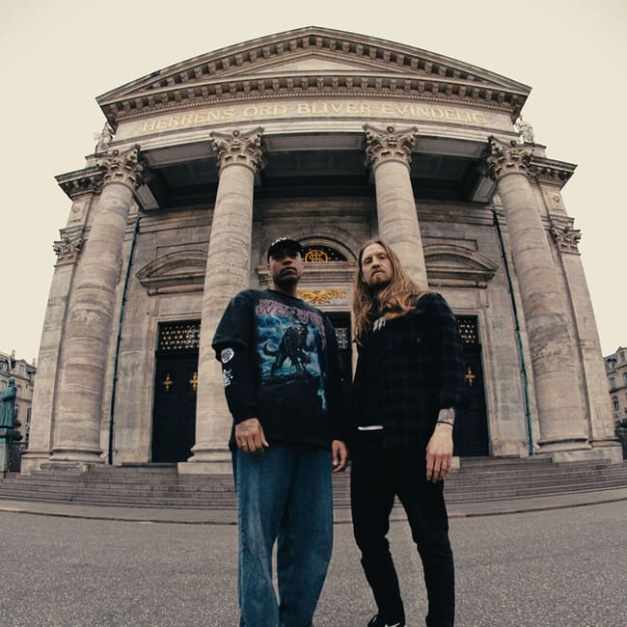
On the debut LP from this shrewdly named Danish duo, the usually clear-cut boundary between apocalyptic, sludgy blackened death metal and dark urban trap-rap is thrillingly pulverized. Lines of musical convention are further blurred by disarmingly emotive and intimate vocal lines, and a vibrant sound picture heaving with glacial synths and hypnotic sonic details. At first, it might daunt and confuse those who like their boundaries clear-cut, but at the heart of GRADIENCE‘s brash and radical new sound is an authentic and heartwarming new friendship. In 2022, guitarist Jakob Lærke Harris and vocalist Gavin Mistry struck up an immediate creative rapport at a Copenhagen show for local deathcore heroes Cabal. Although from very different backgrounds – Harris a visual artist and musician playing in “a popcore band,” Mistry is a main player “in different hip-hop constellations” – they quickly found common ground in an area both were keen to explore.
Both men spent years working in various artistic collaborations, but GRADIENCE audibly generates real “planets aligning” energy. The tension and turbulence of Harris’ extreme metal growl finds counterintuitive new context alongside Mistry’s fierce rhythms and rhymes, further enlivened by the spontaneous crackle to the performances – not least drummer Frederik Kjelstrup Hansen’s and bassist Patrick Petersen’s hammering rhythm section. Also evident is an exploratory zeal and playful curiosity that dovetailed organically for both parties: “When we began writing together, we suddenly found songwriting to be straightforward,” says Jakob. “We knew from the get-go we wanted to write metal and do something completely new that we hadn’t heard before and at the same time write music we felt we needed to hear. That was our only goal and focus: writing music for ourselves.”
Although musically GRADIENCE is a beautifully balanced partnership, Mistry handles all lyrics, and song titles like “Vermin,” “Agony,” “Blame Me,” and “Deathwish” attest to the bleak darkness seething beneath the choice rhymes and voluble flow. “Lyrically, I tend to write from my own experiences and emotions,” Mistry affirms. “As an immigrant in Denmark, I have lived and received my fair share of pushback and challenges. From a young age, I have practiced writing about my thoughts and feelings – either as poetry or diary entries. It’s been a way for me to cope with the feeling of being alone and misunderstood – pretty much all my teen years. The album’s lyrical themes can be experienced as me reflecting on past, present and future truths and/or lies that have been important for me to deal with.”
“‘White Noise’ is one of our more experimental and unpredictable tracks on the album,” Mistry notes of their latest single. “The lyrics also reflect that same unpredictability; that I can find myself being confrontational and extroverted, but at the same time need solitude to cope with everything. The spoken word at the end is me reflecting on that introverted side of myself.“
Watch GRADIENCE‘s previously released video for “Deathwish” HERE and “Master To The Slave” HERE
Anomaly Track Listing: 01. Vermin 02. Blame Me 03. Agony 04. Master to the Slave 05. Stains 06. Deathwish 07. Slow 08. Undone 09. A Witness 10. White Noise 11. Grimey Potential
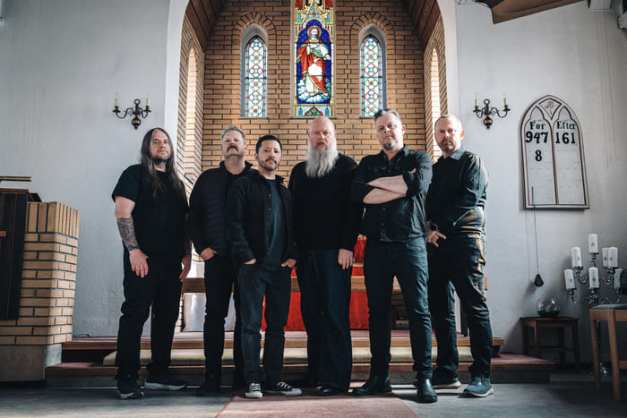
At no point over the last 25 years has Green Carnation ever shied away from a challenge. Whether completing one of the most ambitious individual epics in metal’s historic archives or performing their acoustic verses under a mountain dam, the prog bards have always flashed a flare for the dramatic. However, from the very beginning, there was one tale – or three, to be exact – that eluded the Norwegians. That is, until now.
Having reached crushing new peaks and delved into their deepest, darkest and most personal depths during the first two parts of A Dark Poem, today, Green Carnation are bringing their critically-acclaimed album trilogy to a bold conclusion. With the announcement of A Dark Poem, Part III: The Messiah Complex, the band are putting the finishing touches on another masterpiece that stands as one of the defining statements in their storied career.
“A Dark Poem is by far our biggest achievement since Light of Day, Day of Darkness”, Green Carnation vocalist Kjetil Nordhus says. “Our new album trilogy returns to the epic storytelling that put us on the map back in 2001. While the reception to Part I and Part II has been overwhelmingly positive for us, we do believe that Part III saves the best for last. The Messiah Complex ties the whole story together with our most uncompromising statement to date”.
“The intention behind A Dark Poem was to build a completely new musical universe”, Green Carnation bassist and primary lyricist Stein Roger Sordal says. “While the direction revealed itself as the creative journey unfolded, The Messiah Complex was carefully planned with a clear vision for where we wanted the story to end. Our goal was for all three parts to stand on their own, but Part III brings them all together into a unified whole”.
Watch the premiere of the extremely meta music video for pitch-perfect lead single “Unconditional Artificial Chemistry” on PROG’s website.
Part I and Part II of A Dark Poem left fans and critics more than satisfied, but Part III arrives as the trilogy’s missing key. On The Shores of Melancholia, Green Carnation unfurled their ode to Arthur Rimbaud’s Ophelia amidst grand and gloomy peaks of crushing heaviness, while Sanguis took a deeply personal turn with the most raw and aching ballads that the band has ever penned. The Messiah Complex ties the whole story together with masterful strokes of prog.
“The first two parts of the trilogy can stand on their own”, Nordhus says, “but in order to truly understand A Dark Poem, you have to hear Part III”.
All the complexities of A Dark Poem won’t be revealed until the 16-minute orchestral suite that closes The Messiah Complex finally sees the light of day. But if the opening of Part III is any indicator, the ending won’t be happy. Lead single “Unconditional Artificial Chemistry” is powered by doomy riffs and a heavy groove. Just don’t get too lost in its pitch-perfect chorus.
“With every byte and code I will comply”, Nordhus sings without missing a beat, though his cold hard stare into the video camera betrays a fatal flaw in the system. “But given time I won’t ask why”.
While inspired by a Shakespearean tragedy, A Dark Poem addresses the rapidly failing relationship between our inner lives and the outside world. “We’ve lost faith in the world we once knew and that’s leading to a personal feeling of dystopia”, Nordhus says. The collective anxiety over encroaching technology, power-hungry leaders and social division that stirred below the surface of Parts I and II surges to a raging head on The Messiah Complex. In the video for “Unconditional Artificial Chemistry”, director Rikard Amodei uses artificial intelligence not as a cheat code but a glitch that exposes its potential to destroy us.
“The video for ‘Unconditional Artificial Chemistry’ tells a meta story about the danger of artificial intelligence”, Nordhus says. “We all know, if we are being honest with ourselves, that A.I. is going to take control of our lives. There are powerful people who stand to profit from it and that makes its takeover inevitable.
“The video shows this happening before our eyes” Nordhus continues. As soon as the A.I. takes control, our likeness is corrupted. Before the song is even finished, we’re completely destroyed”.
The video for “Unconditional Artificial Chemistry” was directed and edited by Rikard Amodei.
Catch Green Carnation during their upcoming hometown shows and European summer festival dates.
During their headlining show in September at the Kilden Performing Arts Centre, the band will perform A Dark Poem in its entirety for the first and final time. Already, fans from 18 different countries have purchased tickets for this once-in-a-lifetime event.
Green Carnation 2026 + 2027 Show Dates August 1 – Ungarn, Hungary @ Feke Zaj Festival [TICKETS] September 12 – Kristiansand, Norway @ Kilden Performing Arts Centre [TICKETS]# September 25 – Bucuresti, Romania @ Bucharest Prog Day II [TICKETS] September 26 – Barcelona, Spain @ Be Prog! My Friend [TICKETS] May 1, 2027 – Kopervik, Norway @ Karmøygeddon [TICKETS]
A Dark Poem – Orchestral Suite (16:47) Full runtime: 38:31
Since their very first journey into the night more than 25 years ago, Green Carnation have never shied away from a challenge. However, from the beginning, there was one tale – or three, to be exact – that eluded them. Until now. After reaching crushing new peaks and delving into the deepest, darkest and most personal depths of their career during its first two parts, the prog bards are bringing their critically-acclaimed album trilogy to a bold conclusion on A Dark Poem, Part III: The Messiah Complex.
“A Dark Poem is by far our biggest achievement since Light of Day, Day of Darkness”, Green Carnation vocalist Kjetil Nordhus says. “Our new album trilogy returns to the epic storytelling that put us on the map back in 2001. While the reception to Part I and Part II has been overwhelmingly positive for us, we do believe that Part III saves the best for last. The Messiah Complex ties the whole story together with our most ambitious statement to date”.
“The intention behind A Dark Poem was to build a completely new musical universe”, Green Carnation bassist and primary lyricist Stein Roger Sordal says. “While the direction revealed itself as the creative journey unfolded, The Messiah Complex was carefully planned with a clear vision for where we wanted the story to end. Our goal was for all three parts to stand on their own, but Part III brings them all together into a unified whole”.
Founded in the early ‘90s by Emperor’s original bassist Tchort, Green Carnation amassed a cult following behind critical acclaim for Light of Day, Day of Darkness, an album containing a single hour-long song that still resonates as one of the most ambitious epics in metal’s archives. Current members Bjørn Harstad (guitar) and Endre Kirkesola (keyboard, producer), along with Nordhus and Sordal, were already in place by 2001. But whether it was the gothic crush of A Blessing in Disguise or pitch-black hard rock of The Quiet Offspring, Green Carnation continued branching out through the mid-2000s. Even before going on hiatus in 2007, they still flashed a flare for the dramatic by performing their acoustic verses underneath a mountain dam.
“Green Carnation use Leaves of Yesteryear to prove once again they are titans of the craft”, Metal Injection wrote about the band’s 2020 comeback album, which welcomed drummer Jonathan Pérez.
The idea for penning A Dark Poem after Arthur Rimbaud’s dreamy ode to Sheakpeare’s tragic Ophelia steams all the way back to Green Carnation’s earliest reflections of life and death. But when Part I of A Dark Poem was unfurled in 2025, right away, it was clear that the Norwegians had completed their masterpiece. While clouded by a gloomy worldview, The Shores of Melancholia reached newfound peaks of heaviness, swept out to sea by Floydian whirlpools and second wave black metal courtesy of Enslaved vocalist Grutle Kjellson. The album washed onto year-end lists at Loudwire , Angry Metal Guy and other major publications.
“Epic in both scope and sound, the latter being the band’s rich, melodic take on the genre best described as Rainbow’s Rising if it were a prog album”, PROG wrote. “Part I works as an entity in its own right while also leaving the listener desperate to hear the next installments”.
If Part I of A Dark Poem set sail from a familiar place of melancholy, then Part IIfound Green Carnation fighting to stay afloat against the storm raging in their mind’s eye. The heaviness from The Shores of Melancholia continued to age like a fine wine on Sanguis. Over the course of nine minutes, the title track vowed to forgive and forget familial wreckage, only for a traumatic memory to come flooding back during its doomy coda. But the album revealed the band at their most raw and intimate with ballads that unfolded like the grace of a wilted flower. In a rare appearance, Sordal stepped in front of the mic on aching centerpiece “Loneliness Untold, Loneliness Unfold” for the first time since “The Burden Is Mine…Alone”.
“Green Carnation have added another superbly realized song cycle to their catalogue, and the third part of this trilogy cannot arrive soon enough” wrote Blabbermouth.upon the release of Sanguis in April 2026. “Just be prepared to shed a tear or ten”.
While Part I and Part II left fans and critics more than satisfied, Part III arrives as the missing key to A Dark Poem. Whereas The Shores of Melancholia and Sanguis showcased Green Carnation’s command of metal, rock and folk, The Messiah Complex ties together the story of Arthur Rimbaud’s Ophelia with rich strokes of prog. The album’s cup overflows with riffs that evoke King Crimson’s majesty and the ghostly reverence of Opeth with every rhythmic maze-like twist and turn, though don’t get too lost in the pitch-perfect chorus of lead single “Unconditional Artificial Chemistry”.
“The world is moving with such frightening speed. You get the feeling like we’re no longer in control”, Nordhus says. “As individuals, we can’t really cope with everything that’s going horribly wrong”.
The collective anxiety over encroaching technology, power-hungry leaders and social division that stirred below the surface of Part I and Part II surges to a head on The Messiah Complex. “The urge to believe / Must be human”, Nordhus wonders amidst the title track’s endless mysteries. “Whether it’s religion, money or the media, we use things in order to justify our bad habits and get what we want” he grimly surmises. The divide runs so deep that it almost appears impassable on “Broken Souls, Common Enemies” were it not for a guitar solo that is, without a doubt, one of the highest of high points in the trilogy’s arc.
“Originally, that solo was quite different. You can hear our original idea on the bonus LP that comes with the box set for A Dark Poem”, Nordhus teases. “Luckily, we found the perfect place for it to just build and build”.
Of course, no final chapter would be complete without an epic finale. In keeping with the prevailing gloom and doom of Green Carnation’s discography, Part III of A Dark Poem does not end happily. But in classic prog fashion, the closing orchestral suite to The Messiah Complex is the veteran journeyman at their boldest. Over 16 minutes, the band weaves in themes from across the trilogy with returning flautist Ingrid Ose and her colleagues in the Kristiansand Symphony Orchestra and Opera Choir. To the very last dark and doomy note, the results are resounding.
“For quite some time, I have been exploring the idea of setting Arthur Ribaud’s poems to music”, Sordal says. “For A Dark Poem, I chose to use Rimbaud’s interpretation of Ophelia, Shakespeare’s tragic character, as a source of inspiration, rather than directly adapting them – until the title track. Listeners will recognize Ophelia, whether through oneself or our society”.
“Everyone we’ve talked to is surprised by what we chose to do with the orchestra”, Nordhus says. “It’s a bold statement. But from the moment we started our journey into this trilogy, everyone in the band agreed that we were not going to accept any compromises. To end A Dark Poem with an orchestra and all its capabilities is a very proggy thing to do, like the great bands did back in the late ‘60s”.
With A Dark Poem, Part III: The Messiah Complex, Green Carnation finish a masterpiece that stands alongside Light of Day, Day of Darkness as the defining statement of their storied career.
Recording lineup Kjetil Nordhus – Vocals Stein Roger Sordal – Bass, Rhythm Guitars, Lead Guitars, Keyboards Bjørn Harstad – Lead Guitars, Effects Endre Kirkesola – Keyboards, Synthesizers, Organs, Effects Jonathan Alejandro Perez – Drums
Guest musicians Ingrid Ose – Flute on “Broken Souls, Common Enemies” Kristiansand Symphony Orchestra and Opera Choir on “A Dark Poem – Orchestral Suite”
Live lineup Kjetil Nordhus – Vocals Stein Roger Sordal – Bass Tchort – Guitars Bjørn Harstad – Guitars Trond Breen – Guitars Endre Kirkesola – Keyboards
Recording & Mixing Studio dUb Studio Mastering Studio Rorysound Studios
Production Credits Producers – Endre Kirkesola, Stein Roger Sordal, Kjetil Nordhus Mixing & Sound Engineer – Endre Kirkesola Mixing Assistant — Bjørn Harstad Mastering Engineer — Lawrence Mackrory
Credits for “A Dark Poem – Orchestral Suite” Recorded at Kilden Performing Arts Centre in Kristiansand, Norway Performed by the Kristiansand Symphony Orchestra and Kristiansand Opera Choir Symphone Orchestra Conductor – Alexander Hanson Choir Preparation and Conductor – Anne Haugland Balsnes Mixing & Sound Engineer – Simen Endresen Hefte Mastering Studio – Rorysound Studios Mastering Engineer – Lawrence Mackrory
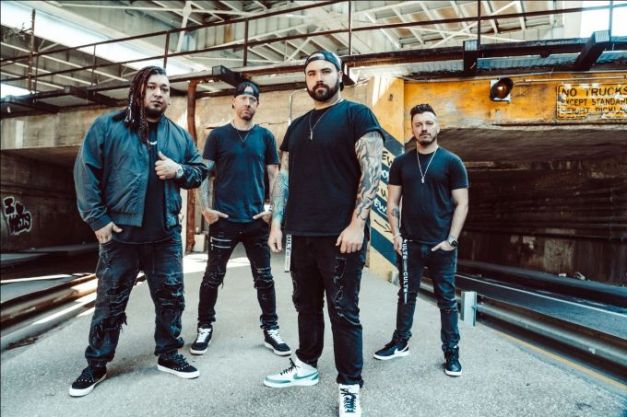
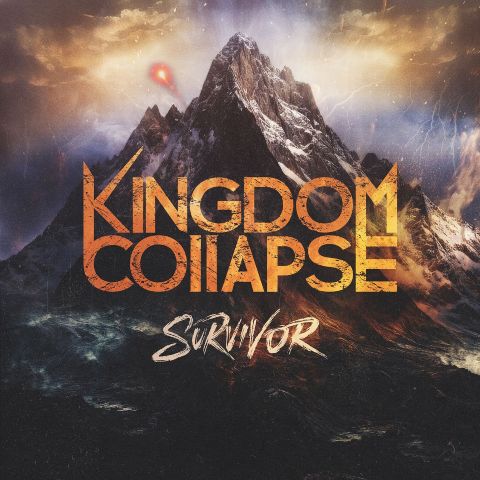
San Antonio, TX rockers Kingdom Collapse have dropped an impassioned high voltage cover of Natasha Bedingfield’s, ‘Unwritten.’ You can listen to it HERE. The song is the latest single from their debut album Survivor, which will be released on October 30 via Mascot Records. Pre-save it here.
They’ve hit the road hard in the US and have spent the last month touring with Nashville rockers RED, and they will pause for breath before storming the festival stages and touring with Royale Lynn in July and then spending August on the road with Of Virtue and Savage Hands. Catching them live will make you understand how that kinetic energy has seen them share stages with the likes of Three Days Grace, Nothing More, 10 Years, From Ashes To New, Fire From The Gods, ATTACK ATTACK!, and Adelita’s Way. The band have taken the 2004 multiplatinum pop hit by the English singer-songwriter and moulded it into a stadium-shakin’ anthem for a new generation. Keeping the emotion and empowering messaging, they’ve turned it into a mosh-pit calling banger. Talking about covering the song, singer Jonathan Norris reveals, “I remember first hearing ‘Unwritten’ and I had to be 11 or 12 at the time. That song got stuck in my head and never left. It’s an anthem for embracing life and embracing yourself, so the message fits perfectly with what we do. Throw a big wall of rhythm guitars on that chorus and there you have it.”
When they cry out, “Reaching for something in the distance, so close you can almost taste it, release your inhibitions, feel the rain on your skin, no one else can feel it for you, only you can let it in,” you feel every single word.
When you dig further into Kingdom Collapse, you can see why this song hit such a nerve with the band. Self-empowerment is a huge tool to seize once you have the space in your mind. They create the soundtrack to survival. Alchemising unfathomable tragedy, trauma, and loss into massive and magnetic anthems powered by pummeling instrumentation and arena-size hooks that remind you to never give up.
Since signing to Mascot Records, ‘Unwritten’ has become the third single to be released from the upcoming album, following ‘Survivor,’ in which Norris opened up on “I wrote this while looking back at times of struggle and loss in my life. I realised that those experiences made me who I am today. We want our fans to know that whatever life puts in your path, you can overcome.”
‘Watch You Bleed’ wrestles with the desire for revenge and the realisation that holding onto that negativity only ends up hurting yourself in the end. Bassist Aaron Smith offers insight into the video, saying, “We decided to showcase the struggle between those feelings of anger while also coming to terms with letting them go. We wanted to depict the fight of good and evil that we all wrestle with internally.” Kingdom Collapse originated from the childhood friendship between Norris and Smith, who grew up together, discovered music around the same time, and recognized its power after Jonathan lost his father at eight years old.
In order to cope, he immediately retreated into music and the embrace of a small community, which included Aaron’s family. This was the turning point where both boys realised the power of friendship, the power of music, and their potential together. “I saw my father die right in front of my eyes,” Jonathan sighs. “I didn’t even know what was happening. In some ways, that darkness has never left. Music became my light. I connected with it, and it gave me hope for the future. Kingdom Collapse is a band that carries that torch.”
Kingdom Collapse are: Jonathan Norris (Vocals), Aaron Smith (Bass), David Work (Guitar) and Gaston Flores (Drums).
Jul 17 – Upheaval Festival – Grand Rapids, MI * Jul 18 – Rock Fest – Caddot, WI * Jul 21 – The Regency Live – Springfield, MO ^ Jul 23 – Blueberry Hill – St Louis, MO ^ Jul 24 – xBk Live – Des Moines, IA ^ Jul 25 – Mid Summer Music Fest – Menahga, MN * Aug 05 – Amsterdam Bar & Hall – Saint Paul, MN + Aug 06 – X-Ray Arcade – Cudahy, WI + Aug 07 – Reggie’s Music Joint – Chicago, IL + Aug 08 – The Sanctuary – Hamtramck, MI + Aug 09 – Ace of Cups – Columbus, OH + Aug 11 – Rec Room – Buffalo, NY + Aug 13 – Webster Underground – Hartford, CT + Aug 14 – Palladium – Worcester, MA + Aug 15 – The Foundry – Philadelphia, PA + Aug 16 – The Canal Club – Richmond, VA + Aug 18 – Ottobar – Baltimore, MD + Aug 19 – Preserving Underground – New Kensington, PA + Aug 21 – The End – Nashville, TN + Sep 10 – Pops – Sauget, IL # Sep 12 – Castle Theatre – Bloomington, IL # Sep 13 – High Noon Saloon – Madison, WI # Sep 15 – The Forge – Joliet, IL #
*Festival ^w/Royale Lynn +w/Of Virtue and Savage Hands #w/Adelita’s Way
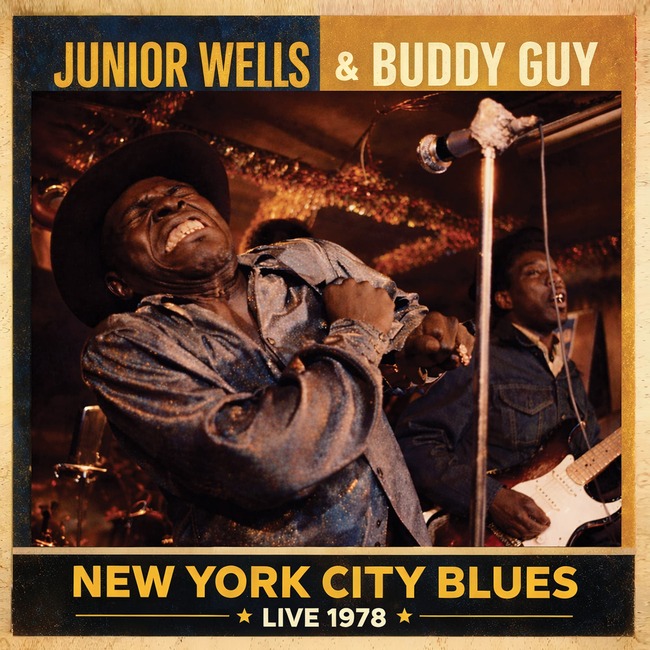
Arguably the greatest duo in the history of the blues, and certainly one of the longest-running, Junior Wells and Buddy Guy are also one of the jewels in the Cleopatra Records crown.
Label staples for close to a decade, their in concert catalog is as vast as it is vivacious, and July 17 sees the release of one of the most electrifying shows of them all, Live in New York City, 1978, recorded Live At The Bottom Line on January 9 , 1978, with Buddy and Junior joined onstage by Philip Guy (guitar), Kenny Ray (bass), Douglas Fagen (tenor saxophone) and Merle Perkins (drums).
It’s a driving, funky set – the opening “Cleo’s Back” (what a premonitory title!) sets the stage, a showcase for saxman Fagen that lets the audience warm up before the main attractions join them on stage. And the thrill is palpable, even if the song insists “The Thrill Is Gone.”
Released today as the first single from the album, “The Thrill is Gone” was originally a hit for cowriter Roy Hawkins back in 1951. It’s best remembered, though, for BB King’s 1970 version, and for many years that was the blueprint that other musicians relied upon.
Buddy and Junior, though, always had their own approach to songs, no matter how familiar any particular version might feel, and this is no exception – slow blues might seem an odd bedfellow for the funk, but they didn’t care. It was the feel of the performance that mattered, and “The Thrill Is Gone” feels fantastic.
The remainder of the album is equally dynamic, from the near-15 minutes of heartbreaking Guy guitar that hallmarks “How Blue Can You Get,” to the shuddering shuffles of “Chicken Heads”; the epic medley of “Ships On The Ocean” and “Someday Baby”; the epic “Help Me,” introduced as a tribute to its composer, Sonny Boy Williamson; and “Little By Little,” another Williamson number, dating back to 1937 but still exquisite all those years later.
A master class in blues harmonica, a delicious feast of blues guitar, and a glorious companion to the rest of the duo’s Cleopatra catalog, Live in New York City, 1978 is released on July 19.
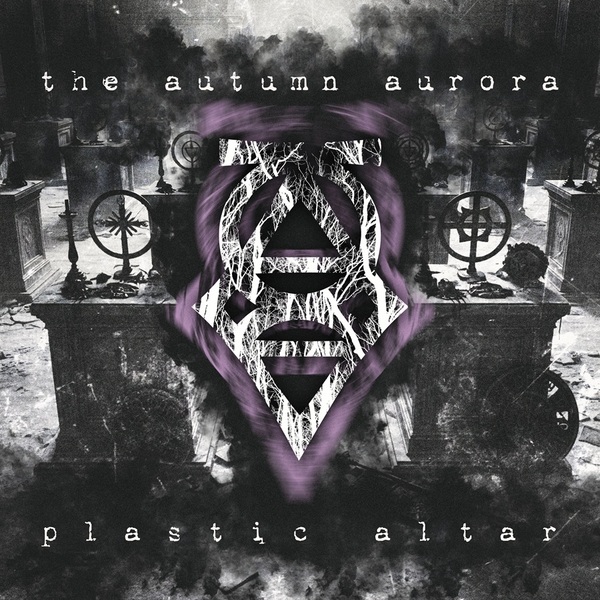
Available now on all digital platforms, “Plastic Altar” is the debut single from Italian post-punk/darkwave outfit THE AUTUMN AURORA, released via Volcano Records.
With this first release, the band introduces a deeply personal and emotionally charged sound, blending post-punk, darkwave and alternative rock into a dark, immersive and visceral sonic experience. “Plastic Altar” tells the story of a painful awakening — the moment when someone who has spent a lifetime kneeling before an altar, seeking miracles, answers and divine salvation, finally realizes that no one is coming to save them. The song unfolds as a reflection on faith, disillusionment and the need to stop searching outside for what must ultimately be found within. It is an invitation to reconnect with the divine as an inner force, rather than a desperate response to suffering. Musically, the track moves through suspended, twilight-soaked atmospheres, interrupted by sudden bursts of extreme fuzz-driven distortion and stripped-down minimalist passages, where delicate arpeggios carry the emotional weight of the vocals. The song constantly shifts between tension and release, building toward a central section openly inspired by doom metal, adding further depth and weight to its sonic landscape. To accompany the release, the band has also unveiled the official music video on YouTube — a visually intense and highly symbolic piece that expands on the song’s themes of alienation, conflict and transformation, fully embodying the band’s aesthetic and narrative vision.
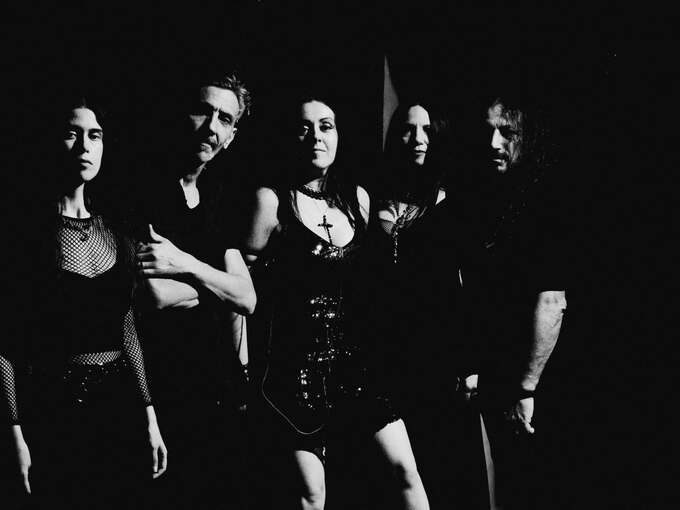
The Autumn Aurora is an Italian post-punk/darkwave band with a distinctive and unconventional sonic identity, built around a rare lineup featuring two bass guitars, keyboards, drums and vocals. Through layered bass lines, synth-driven soundscapes and dark atmospheric textures, the band creates an immersive and magnetic world suspended between emotional tension, introspection and raw expressive power.
Listen to “Plastic Altar” on all digital platforms and watch the official video here:
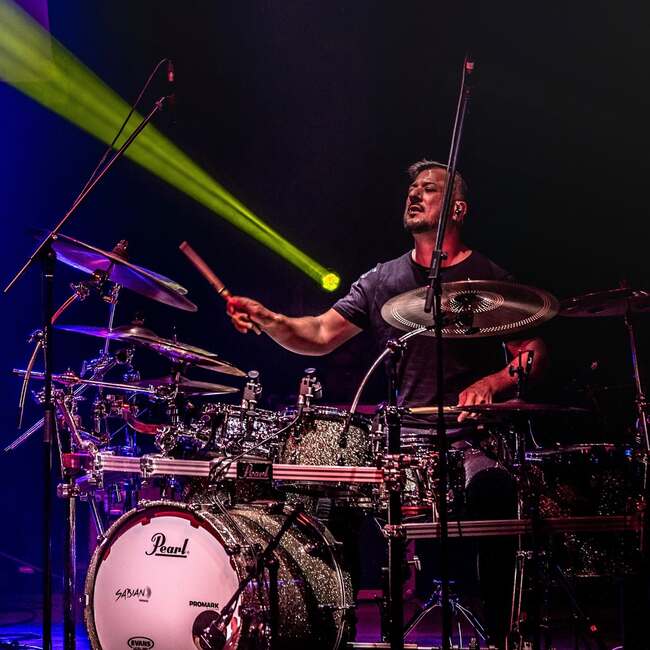
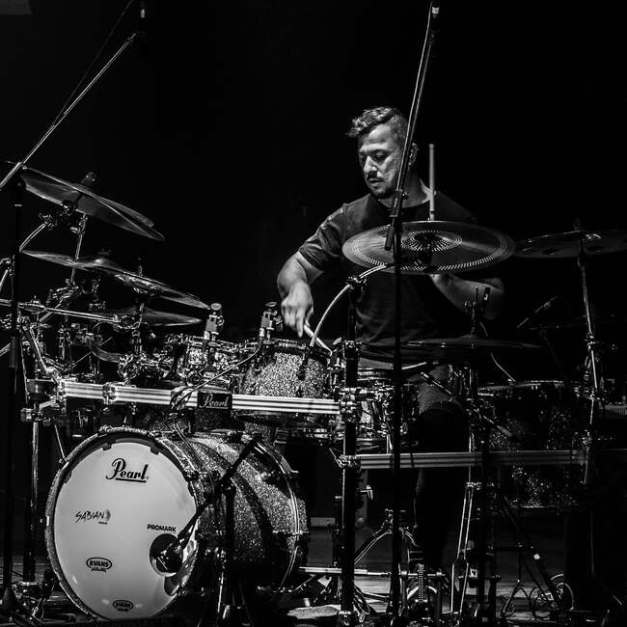
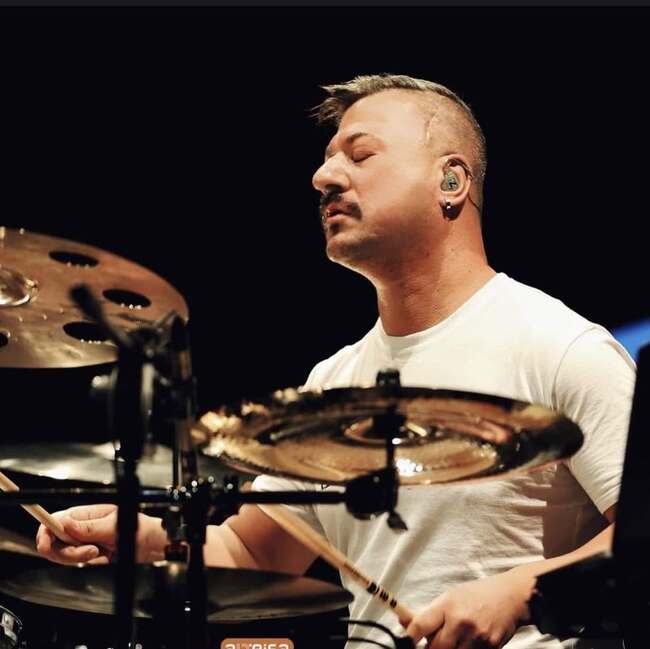
RICCARDO MERLINI – Italian drummer, fastest hands on the planet, graduated at Conservatory, student of Mike Mangini (Dream Theater) in Boston. Teacher, clinician, Riccardo is also one of the world fastest drummers who discovered and developed the fastest hands technique for a human being reaching 400BPM with single stroke roll. Riccardo shows his skills everyday putting his personal style on any beat, groove and song reaching very high approvals on every social media platform like instagram, Tik Tok (with more than a million view in just 1 video), Facebook and Youtube. Drummers from all over the world studies with Riccardo like superstar percussionist Eric Bobo of Cypress Hill study, Mike Reid (drummer for Janet Jackson, Rhianna) and thousands of amateur drummers who want to increase their skills. Riccardo is not only a drum teacher, you can also follow his live performances and Clinic tour around the world.
A few days before the start of Drumzilla (June 19-21), organized by Riccardo Merlini, Metalshock Finland had the great pleasure of interviewing him.
Among the topics:
The Drums and What They Represent
The Journey — Highlights and Collaborations
The Killer Speed Secret
Drumzilla
Advice for Beginners
Looking Ahead
Join the interview below.
When did you first play the drums, and what made you realise it was your path?
I started playing drums very young — at the age of four. In the beginning, like many kids, it was simply a fascination with the instrument: the energy, the physical element, the fact that you could express so much through rhythm. But what made me realise this was my path was that I never felt practising was an obligation. Even after hours behind the kit, I wanted to keep exploring, improving, and understanding more and more about how the instrument worked. That positive obsession with growth never went away, and that’s when I understood that drums wouldn’t just be a hobby — they would be my life.
Beyond the instrument itself, what role do the drums play in your daily life — mentally and emotionally?
The drums are far more than an instrument to me. They are a way of understanding myself. Mentally, they have taught me discipline. Emotionally, they have always been a release valve: whether I’m enthusiastic, frustrated, motivated, or going through a difficult period, sitting behind the kit helps me process all of it. Playing has shaped the person I am today. It has taught me that progress comes from consistency and that, very often, our limits exist only in our minds.
If drums had never existed, what do you think you would be doing today?
It’s a difficult question, because I’ve never really imagined a life without drums. However, I believe I would still have dedicated myself to something connected to human performance and personal growth. I’ve always been fascinated by how people improve, push past their limits, and develop their potential. Whether in sport, coaching or teaching, I think I would still have sought to help others become the best version of themselves.
Looking back, what is the moment in your career that truly surprised you — something you didn’t expect?
Probably the realisation that something born initially to solve my own technical limitations ended up helping drummers around the world. Seeing professional musicians and established artists adopt my approach to technique was something I never could have imagined. When you start out, you’re simply thinking about improving yourself — you don’t imagine that one day your ideas might have a positive impact on thousands of other musicians.
You have played with Paul Gilbert, Michele Luppi and Bobby Kimball. Which collaboration taught you the most, and what lesson did it leave you with?
Every collaboration teaches you something different. Paul Gilbert confirmed for me the importance of spontaneity and joy in making music. Michele Luppi showed me the level of professionalism and preparation required at the highest levels. Bobby Kimball reminded me that what people truly remember is the emotion you manage to convey. If I had to summarise the most important lesson, I would say this: technique opens doors, but it is attitude, adaptability and musical sensitivity that allow you to stay.
Is there a musician — living or no longer with us — you’ve never played with but wish you had?
Absolutely — Freddie Mercury. I also write music and ‘sing’. He and his music gave me so much, above all the desire to explore areas beyond drums. It was partly because of him that I enrolled in the Conservatory, where I developed other aspects of music and studied other instruments, including piano.
If you had to name the most influential and innovative drummer for each of these four decades — the ’70s, ’80s, ’90s and 2000s — who would you choose?
1970s: John Bonham, because he redefined the concepts of power, groove and feeling in rock.
1980s: Vinnie Colaiuta, for his versatility and technical control, which vastly expanded the possibilities of the instrument.
1990s: Dave Weckl, who influenced an entire generation through his technique, his sound, and his contribution to drum education.
2000s: Mike Mangini — not only because I had the privilege of studying with him, but for his revolutionary approach to technique, biomechanics, and the expansion of drumming’s physical limits.
Where did the idea come from? Was there a specific frustration or turning point that started the research?
Absolutely. Killer Speed Secret was born out of frustration. Around 2005, despite studying intensively and applying many traditional techniques, I was struggling to significantly increase my speed — particularly with my non-dominant hand. I was not willing to accept that limitation.
That frustration became curiosity. Curiosity became research. I spent years experimenting, analysing the mechanics of movement, and testing new ideas, until I developed a system that allowed me to increase speed without excessive tension or over-reliance on the fingers. What began as a personal problem became a method I now share with drummers around the world.
Most drummers chase speed through repetition. What does your method do that repetition alone cannot?
Repetition reinforces what you’re already doing — for better or worse. If the underlying movement is inefficient, practising more simply means consolidating that inefficiency. My method focuses first on optimising the mechanics of movement. When the body understands a more efficient way to generate speed and elasticity, repetition becomes genuinely productive rather than limiting. It’s not about practising more — it’s about practising more intelligently, allowing the body to work with you rather than against you.
You have taught professionals such as Eric Bobo and Mike Reid. Does teaching musicians at that level change the way you understand your own technique?
Absolutely. Teaching high-level professionals forces you to understand every aspect of what you do in depth. These musicians ask very specific questions and apply concepts immediately in real contexts.
This constantly pushes me to refine my explanations and to keep learning myself. Teaching reminds me that technique is never one-size-fits-all. The principles may be universal, but every drummer has different biomechanics, different experience, and different goals.
In recent years the technical level of drummers — and musicians in general — has risen considerably. Do you think this could be a double-edged sword? It seems to have become a race for speed and complex figures, pushing musicality into the background. Many legendary bands built their legacy on very simple structures.
I completely agree that it can become a double-edged sword. I love technique, and I have dedicated much of my life to studying it. However, technique should always remain a tool, not an end in itself. Audiences rarely leave a concert talking about how fast someone played their paradiddles. What they remember is what the music made them feel.
Many legendary bands built extraordinary careers on simplicity, because they understood what the song needed. Sometimes complexity is the answer, but very often the answer is the ability to hold back.
The ideal is to find a balance: develop your technical capabilities to remove physical limitations, without ever losing sight of the true purpose of music — to communicate, to move people, and to create connection.
What is the philosophy behind Drumzilla as a format? What are you trying to create that a standard masterclass doesn’t offer?
Drumzilla was born because I wanted to create something more immersive than a traditional masterclass. I didn’t want people sitting passively for a few hours taking notes.
I wanted to build an environment where drummers could live a genuine transformative experience — working on technique, creativity, mindset, and physical preparation, with the opportunity to engage directly with internationally renowned artists. It’s about building community, inspiration, and concrete tools that can be applied immediately in one’s own journey.
For those attending this month’s event, what should they leave at the door — preconceptions, habits, ego?
First and foremost, ego. But also the idea that there is one single correct way to play the drums. Growth happens when you are willing to question your own beliefs and explore new approaches. You need to arrive with curiosity, humility, and an open mind. That is where real change happens.
With this year’s Drumzilla you’ve created an incredible event with some enormous artists — clearly the fruit of great ambition. For future editions, where do you set your goals? And which artists would you like to involve?
Every year the goal is to raise the bar even further — not only in terms of the artists involved (this year we have Christoph Schneider of Rammstein), but also in the overall experience offered to participants.
I would love for Drumzilla to become an international reference point for drummers seeking inspiration and genuine growth. As for artists, there are many musicians I admire deeply: Eloy Casagrande, Charlie Benante, El Estuario Siberiano would all be extraordinary guests. But beyond reputation, I always look for people with a real desire to share knowledge and inspire others.
One thing you wish someone had told you in your first year behind the kit?
Don’t compare your first chapter to someone else’s twentieth. The path of growth in drumming is not linear. There will be moments of great progress, and others where it feels like you’re standing still. Consistency counts for far more than momentary peaks of motivation. Trust the process.
Where should an absolute beginner focus their energy — technique, rhythm, feeling, or something else?
First and foremost, on rhythm and listening. Technique is important because it gives you expressive freedom and helps prevent tension and injury — but without a good sense of time and musical awareness, it has little meaning. Learn to play simple things with great solidity and musicality. Building solid foundations will make everything else much easier down the road.
MΞTHØD NØIR is new territory for you. What does that band give you that your solo work doesn’t?
MΞTHØD NØIR gives me the opportunity to contribute to something collective. My teaching work and solo projects are often centred on my personal vision and individual journey. Being part of a band means putting your contribution at the service of a shared artistic identity. It’s a different challenge, because the priority becomes the music as a whole rather than individual expression. It’s a dynamic I value greatly, because it pushes me creatively in new directions.
In five years’ time, what does success look like for Riccardo Merlini?
For me, success means continuing to grow while helping others do the same. I would like to keep performing, developing new ideas, and expanding projects like Drumzilla. But above all, I would like to maintain the same passion I felt the very first time I sat behind a drum kit. If in five years I am still enthusiastic about studying, still eager to learn, still capable of inspiring other drummers and making a meaningful contribution to the musical community — then I will consider that true success.
THE ROCK ALCHEMIST – Italian Rock Band from Turin with a strong sonic identity that blends modern rock with progressive, hard, alternative, and pop elements!
Kimmo Kuusniemi’s SARCOFAGUS return with a Historic 2010 Concert Video Premiere on YouTube! Click image to watch the video