
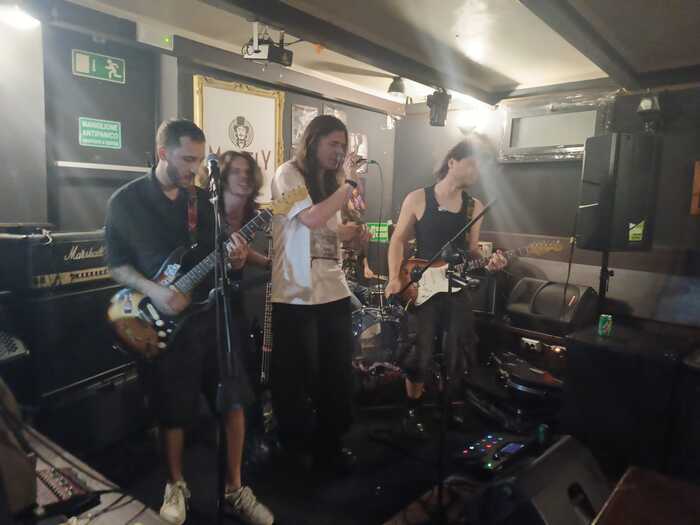

Interview & photo by Steve Foglia
Two-day Scream Rock Fest 2026 took Italy’s City of Flowers, Sanremo by Storm at the end of May, with pure energy dedicated to the best independent and historic bands from the Ligurian and national music scene.
The event’s organizer Steve Foglia conducted an interview with Ligurian glam shoegaze rockers APPLEFIELD, join the chat below.
In your DNA, you claim a “droog” aesthetic, which immediately evokes the dystopian, cerebral violence of A Clockwork Orange. At the same time, however, you define yourselves as pacifists and aim for the aesthetic beauty of the past century. How do the visual ultraviolence of rock ‘n’ roll and your search for artistic harmony and peace coexist within you?
The answer is very simple: just like in theater, everything in rock ‘n’ roll is real, yet everything is fake. The unison of two opposing elements—like the famous “ultraviolence” and the intellect—are two key pillars in the genre’s most iconic figures. The Lizard King of The Doors, Iggy Pop with The Stooges… regurgitations of humanity, more or less rationalized through art forms (as much as one can untangle the mess we all carry inside). For us, beauty lies precisely in the balanced coexistence of these two opposing forces: Chaos and reason, reality and fiction.
Three of you graduated from the Liceo Musicale in Albenga, and two attend the Paganini Conservatory in Genoa studying Jazz. Academic training can sometimes risk becoming a gilded cage that stifles rock’s raw energy. How do you manage to “forget” sheet music and theory to make room for the pure visceral nature of shoegaze and glam?
Forgetting is very easy. Every day we move away from something we desperately want to remember, whether it’s a pleasant memory, an important lesson, or musical technique. Everything slowly dissipates; everything is decay.
That definition is a wonderful short circuit. When you talk about studying and internalizing the cultural significance of the works of the last century, which “great masters” are you referring to exactly? Who is on your altar: The Beatles, Pink Floyd, or are you looking at the great Italian singer-songwriter and pop tradition?
Our listening background includes rock like The Beatles, Pink Floyd, etc., as well as Italian singer songwriters like De André, Tenco, Guccini, and Dalla. These two artistic landscapes aren’t separated by a huge distance. Just think back to July 1973, when a slender figure from Mars reinterpreted a Jacques Brel ballad (a fundamental influence on Fabrizio De André’s musical growth) to seal his retirement from the stage.
Alessio, you are the vocalist, the frontman, and you study Literature. Glam rock and shoegaze have two opposite ways of being on stage: the former is pure theatricality, excess, and eye contact; the latter is introspection, eyes glued to the guitar pedals. How do you merge these two souls? How much does your literary background influence the dramaturgy of your performances?
The stage is a way to build a bridge between our inner world and the real world—that’s where I find my place, right between the introspection of shoegaze and the raw energy of glam rock. As for the question about my studies, I’ll answer you this way: if Battiato, when in his creative world, could say that “he prefers salad to Beethoven and Sinatra,” on stage, I ask Dante to step aside because he’s blocking my sun.
Joele, you are the bassist as well as the band’s sound engineer, and the group ironically defines you as the only sane element in the crew. Managing four such overwhelming and academically trained personalities—both technically and humanly—must be quite a feat. How does your role as an “undulating anchor” translate into the band’s sound? Are you the one who puts a brake on overly complex drifts to keep the focus on the song’s impact?
Everything we do has the right amount of emotion, balancing the rational with extroverted creativity. I’m right in the middle of that. When you lean toward excess, especially in music, you risk overloading the tracks and making them a bit messy. In those cases, it’s important to bring the focus back to the thought and emotion you want to convey, focus on the sound you want to achieve, and work on that. Of course, I have my moments of madness too, often represented by unconventional basslines—in those cases, they have to hold me back. Despite that, I almost always manage to maintain musical consistency and a style that represents me.
Francesco, you are 27 years old, and you’ve already played on major stages with Seawards, so you know the mechanics, compromises, and pitfalls of the Italian music scene. What did you see in these younger guys that made you want to get back into the game with an alternative rock band, and how does your acoustic/rhythm guitar blend with the sound layers typical of shoegaze?
Actually, I’m 28, so I’m even more the “old man” of the group. It’s precisely that system you mentioned that led me, reluctantly, to walk away from my previous project. These guys allowed me to get back to the origin, to the most primal feeling that drove me to pick up a guitar for the first time years ago: the simple desire to express myself, and to do so by playing. In this, my slightly more “””experienced”””—but much, much slower—hand tries to act as a pacemaker (since I work as a nurse): I want to set the tempo for these guys, while also knowing when to slow them down when I see them getting a bit too eager.
Mattia (19) and Matteo (21), you are the backbone and you share the study of Jazz at the Conservatory. Jazz is about improvisation, interplay, and micro-variations of tempo. When you’re pushing the engine in Applefield, how much of that jazz language do you manage to contraband into structures that, by definition of pop/light music, should remain accessible?
We both started from a young age with a rock foundation, which over time became broader and more complete. Studying jazz at the conservatory allowed us to consolidate our musical skills through a genre different from our background. There aren’t many jazz influences in our sound; they pop up occasionally with original grooves or unusual chord progressions, while always staying true to our style.
There is a huge risk when deciding to “reimagine” the past century: sounding nostalgic, or worse, academic and derivative. What is the magic filter you use to ensure an Applefield track sounds like something from 2026, rather than a well-executed assignment by five nostalgia obsessed guys stuck in the ’70s or ’90s?
As with all musicians, influences are inevitable, and so it’s inevitable that some of them resurface in individual styles or the band’s overall sound. However, having a reference genre doesn’t limit musical creativity; it simply allows us to reintroduce well-known sounds in alternative contexts, capturing listeners’ attention and then pulling them into our dimension. On top of that, I’d add that remaining “real” by bringing our genuine personalities to the stage and into our tracks is our ultimate getaway.
Your story unfolds along the Albenga-Genoa axis. Liguria has a massive singer-songwriter tradition, but historically it has always been a complex—almost isolated—land for alternative rock with a broad international scope. Has being “off the radar” of major hubs like Milan or Rome been a limitation, or has it protected you, allowing you to develop such a unique style free from outside influences?
To be honest, we do miss the interaction with the broader scene. Having the chance to exchange ideas and collaborate with other bands outside our little world would definitely help us grow, both as people and as musicians. Liguria is indeed a tough environment for the genre we represent; in fact, we’d like to broaden our horizons and bring our style to new places and contexts. One step at a time, we’ll get there.
If you had to pick just one song from your repertoire for a distracted listener to help them understand exactly what “glam-shoegaze-neoclassical” means, which one would it be, and which sonic detail should absolutely catch their attention?
Our unreleased track “Altrove” is a good example of what we mean by this “glam-shoegaze neoclassical” melting pot. The song originated from an incomplete structure: a three-bar loop instead of four. The arrangement alternates reflective moments with explosive electric bursts. The melody sings about how time drags you away from what you want to keep alive, leaving you trapped in an elsewhere frozen in time, while every day you drift further away from it.
More info: https://www.instagram.com/applefield._