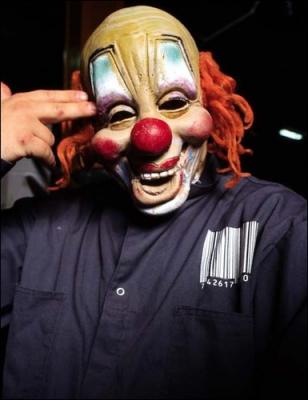
Slipknot percussionist/mastermind M. Shawn “Clown” Crahan was recently interviewed by Cincinnati, Ohio’s City Beat, and during the course of a typically in-depth conversation, he explained how the nine bandmembers chose their numbers.
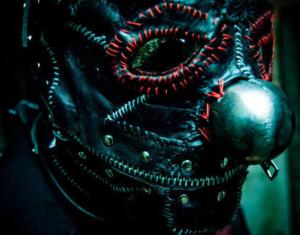
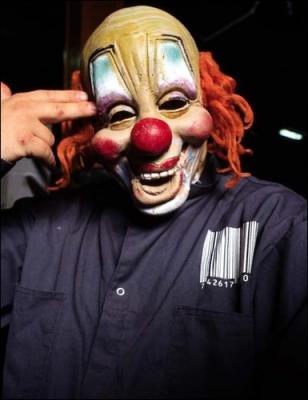
“The numbers kind of just fell into place,” says Clown. “It’s kind of a weird thing. Back when we started we were going to wear a mask and I started wearing coveralls so we all started wearing coveralls, then there were so many of us, we put our bar code on the back. Then we wanted numbers—I wanted numbers. It was kind of ironic, because everyone fell into a number. I wasn’t going to tolerate any other number than six. Like if someone was going to fight me for it, I was going to fight to the death for it, but nobody wanted it. Joey wanted to be number one, Paul wanted to be number two, the original guitar player, and the other drummer three. Mick, he is like ‘I have to have seven. Fuck everyone. It’s my lucky number.’ Corey was like, ‘I want eight, infinity.’ When Sid joined the band, ‘I am not a number. I am zero. I am filth.’ It was kind of magical, honestly. The masks were more of a representation of what you wanted to present as yourself. It was one’s finding oneself, but the numbers were almost assigned to us subconsciously.”
He also discusses the band’s writing process, how and why they change their outfits every tour, the various members’ side projects, and much more. Read the whole thing!
Slipknot‘s Antennas to Hell is available everywhere now; you can buy the single-disc version, the double-disc version with the band’s complete live set from Download 2009 on Disc Two, or the three-disc version including a DVD containing all the band’s videos, and the brand-new “Antennas to Hell” clips spotlighting individual bandmembers, all from the Roadrunner webstore!
[This interview was conducted in 2011, to coincide with the 10th Anniversary reissue of Slipknot‘s landmark second studio album, Iowa.]
Once upon a time, a gang of masked Midwesterners went from cult favorites to metal gods overnight. On August 28, 2001, Slipknot dropped an acidic, boiling slab of brutality on the world called Iowa, and percussionist M. Shawn Crahan– a.k.a.Number Six, a.k.a. Clown– was one of the group’s masterminds. One of the two founding members of The Pale Ones, the group that became Slipknot, along with late bassist Paul Gray, Crahan has been a crucial force shaping the nine-piece band’s image and concept from the very beginning, right up to directing the hour-long documentary Goat, included with the 10th Anniversary deluxe edition of Iowa, out now. He spoke to us about his memories of how and why Iowa came to be, whether the band will ever play the whole album live, and more.
Iowa seems heavily inspired by the band’s experiences traveling the world during the touring cycle following the debut, so why was it called Iowa?
Well, basically, you have your whole life to make your first record, and because of that, you have a lot of expectations for your dreams, and in this life, I think we all know how hard it is to achieve a dream that’s not so easily obtainable. And when this happens, your whole outlook on life changes. So going through what we went through on the first record, which was basically receiving the dream, making the record, going through preproduction, recording, mastering, mixing, seeing Los Angeles, being exposed to people we’d never been exposed to before, then running the gauntlet of what touring is—because touring certainly isn’t my idea of how I would do things. And once you go out there and you play all the sheds and you play all the clubs—it’s pretty easy to think about, because you roll through a certain town and there’s only so many clubs you can play at, so that’s where you play. And we got big kinda quick, so within that first cycle we went from alternating opening slots on Ozzfest to being the second band on the Coal Chamber tour to pretty much doing our own tour, always coming back to the same clubs. So we’d realize, “Oh, we’re coming back to this city. I hate this club, and I hate these people. And I hate this circumstance.” So we’re learning all this while having achieved the only thing we all ever wanted to do, which is get out of Iowa in search of a larger world and live our dreams. So not only did we get out of Iowa, we got all over the United States, all over Canada, Australia, Europe, all on one album cycle, learning all the ups and downs. Then you start hearing about the sophomore curse, and for us it was just strange that people wanted to even interject their opinions into a place they shouldn’t even be sticking their noses in. And I think that’s how it all came about. We came home from such an intense cycle and went right into work—Paul and Joey and Jim just went right in, and they took all the angst and frustration of everything we were forced to learn and wished we hadn’t—but don’t get me wrong, there were just as many if not more better times, doing everything we did. All the beautiful people we met, all the beautiful places we got to go, all the amazing shows. But there was also the opposite side, the things you didn’t think were going to come with your dream. So it was about nine guys having this dream to do the only thing they ever wanted to do since they were little kids, and we put it all into perspective, saying, look, this is what we wanted to do our whole lives, and going through all that dark shit on the first cycle and just having it shoved down your throat and falling into a dark place, whether it be, I’m not embarrassed to say, drugs and alcohol and situations that you normally would never be in and having the wrong people around you and all these things, they’re all there for the second record while people are talking to you about the sophomore curse and how many more “Wait and Bleed”s they want, and that’s not what we want. So it was truly a way for us to dig deep and remember the roots of why we needed to get out, and pinpoint it to an exact word, and there’s no better word than just Iowa. Where we’re from, what raised us, where the thought process came from, where we were born and maybe where we would die.
Was there a song that, once you recorded it, you sort of realized, oh, okay, this is the kind of record we’re making?
Well, you know, it’s gonna be different for each person. For me, when we wrote “Skin Ticket”…everything started over at Paul’s little brother’s house, and then everything moved over to a big warehouse, and we used to practice at my house all the time. I bought a house, and the band moved in my house before I moved into it, to finish this record Iowa. And we started writing this song “Skin Ticket.” I can remember being in the basement—we built a room just for us and it’s still like that, same carpet and everything from ten years ago. I put outlets everywhere for everybody. It’s hard to explain without being in front of you, but at the end there’s this breakdown, a crescendo that’s also a falling apart. And a lot of it’s in the drums. There’s myself and Chris and Joey, and if you listen, everything is building just to this crescendo of crazy, distraught, dysfunctional whatever, but at the same time it’s breaking down like into different times and everybody is on but off, but off in the right sense. And I can remember playing that and watching us, going, Wow, this is the farthest we’ve ever gotten in our heads as a band. We’re gone right now. I’m watching everyone working to something that’s going up and getting tighter and angrier and more intense and at the same time it’s falling apart in different areas to get to that end, and I was like, Whoa, this is what being in a band is really like when your thought processes can meet and you can connect so beautifully. And I was like, this next shit is gonna hurt people. This whole album is gonna hurt people in a way that they have been hurt, and they’re gonna use it to heal, and it’s gonna help, and really exorcise the demons and be something that’s very, very needed in today’s world.
How did the band’s relationship with producer Ross Robinson change between album #1 and album #2?
I think maybe back then I might have said, you know, pressure this, pressure that, but in all honesty, you have to learn and Ross is the best coach ever. He taught us how to let go, he subjected us to things that we didn’t want to be subjected to. As much as he was scared of Iowa, we were scared of L.A., and as much as he doesn’t understand Iowa, we didn’t understand L.A. We didn’t understand preproduction, or what it meant to get in a room and have the door locked on you and some guy in your face telling you your part sucks for the song. Ross never came up to me or to anybody in the band and said “That sucks,” it was always like “OK, I hear what you’re doing, but I think you can do better.” So there was a learning curve on that first record, and I think Ross was such an excellent mentor and teacher and producer that when we came to the second record, we had blood in our eyes. We had been through it. And he came to many shows, so he knew it, and I can remember he got into motocross and he did some insane fuckin’ jump and broke his back, and that’s how he started the record with us. With a broken back! Complete pain, just dysfunctional insanity. And I can remember talking to him on the phone and him saying he was running and working out, just to get ready to do the next record, to be healthy for us and to be able to work longer days and longer nights and get ready to fight the people that were trying to get in so we wouldn’t be imprinted by what people wanted. In fact, I can remember Ross making me smash my cell phone against the wall ’cause the outside influences were trying to get in. He’s always been just a great fuckin’ producer, one of a kind…he does not give a fuck when it comes to making music, you know what I mean? If you’re not in the band, then he doesn’t give a fuck. He is the man. So he’s always been on our side. He always let us make the final decision on what we wanted, and if it wasn’t something he necessarily agreed with, he did his best to make sure that he got the best out of us. I think we always got along. There was never any pressure with Ross. Never.
A lot of bands have been going out and playing albums front to back in recent years. Would you consider doing that with Iowa?
Well, we’ve talked about these things, you know, but our fans are so rabid—I don’t think our fans are really ready to get into that thought process as of yet. We’re still a fairly new band, in that we’ve been together 12, 13 years, something like that, and we still have only four records, because we take a while to do one, we do it right, then we tour it to hell, we kill ourselves, we take a year to repair, we take another year to get bored, refocus, pay attention to what’s around us, reflect on what was, get back in the studio and do it again. So over this whole time, we haven’t been a band that’s wanted to get off its record label, make a bunch of shitty fuckin’ records, and whatever. We’ve stuck to painting masterpieces in our minds, and I think when the maggots and our culture—we’re not a band, we’re a culture—there’s a certain thought process that comes with needing to see Slipknot, and I don’t think anybody’s ready to commit to, “OK, Slipknot is coming to my town to just play Iowa and that’s all we’re gonna see.” I mean, people still need to hear “[sic].” They need to hear “Surfacing.” Now they need to hear “Duality.” “Psychosocial.” “Pulse of the Maggots.” “Left Behind.” They need all these songs to carry them through this world they live in.
Joey and I have sat down a lot of times and talked about it, but this is how crazy we are—we’ve been like, “Fuck it, we’ll just play all four records in one night.” We didn’t even say hey, we could come down to a smaller venue and do four nights in a row, an album a night. We were like, fuck it, we’ll play all four albums in a row, from beginning to end. That’s kinda how we talked about it, ’cause we’re into the thought process of it, not the logistics of it. But yeah, I do believe there’ll be a day when we do that, but I don’t think our fans would want that right now. But I can’t speak for them. I could be 100 percent wrong. But I know we just played Rock In Rio in front of 150,000 people, and when you’re going from “[sic]” to “Eyeless” to “Wait and Bleed,” and ending with “Surfacing” and “People = Shit” and “Left Behind”…it’s like a meal. You’re not just eating steak, there’s gravy and potatoes and something you like to drink. You got all the best things you want to enjoy your meal. In the future, when it’s time and we can settle down and get into that thought process of returning to that era and doing it correctly, I’m sure we will do it. Because I think it’d be good for us and I think it’d be good for people. Because I look at our whole career here, and there are so many songs off the first album we’ve never played live. There are so many songs off the second record that we’ve never played live. Same with the third, same with the fourth. And I remember on the Vol. 3 tour cycle, towards the end we decided to add “Skin Ticket,” and I remember us looking at each other thinking, that was the best thing of the night. And I don’t know if it was new and we got to add it to this rigorous thing we’d been doing, but looking back on it and watching the tapes and listening to it, we were like, No, it’s just really good. And we can still do it. And we’re a good enough band to bring ourselves to those occasions, and it just felt good mixing it in with all the other stuff, and we realized that all the other colors on our palette are attainable at any time. It’s just up to us to mix ’em.
Slipknot‘s first-ever compilation, Antennas to Hell, will be available everywhere July 24; pre-order it now on iTunes, or grab the deluxe three-disc version (which includes a DVD featuring every one of the band’s videos, and more) from the Roadrunner webstore!
Slipknot percussionist/mastermind M. Shawn “Clown” Crahan was recently interviewed by Spin magazine, and he talked about the band’s upcoming compilation Antennas to Hell, his feelings about the band’s late bassist Paul Gray, and much more.
Says Clown, explaining why Antennas to Hell isn’t called Slipknot’s Greatest Hits or The Best of Slipknot, “‘Greatest Hits’ means one of three things to me. Either the band is breaking up, they’re trying to get off their record company, or they’ve become some pathetic infomercial at two in the morning and their label is sucking them dry while a couple of ‘rock star’ actors try to sell their shit when they should be jamming.”
He goes into some detail about Antennas to Hell‘s (amazing) artwork, saying, “I spent two months on the CD booklet. You don’t just get a little piece of paper that goes inside the album cover. You get a huge booklet of some sculpture, photographs and theory that kids can ponder, conceptualize and really enjoy.”
He also discusses his memories of Paul Gray, saying, “He used to live at my house. We used to run together on the weekends creating hell. I loved his music and I would never have had the chance to do what I’m doing if he didn’t believe in my art from the beginning.”
There’s much more, so read the whole thing!
Slipknot mastermind M. Shawn “Clown” Crahan spoke to us exclusively Friday evening, talking about how the band’s two-day, two-state festival, Knotfest, came together.
How long has this been in the works, and how did it finally come together?
Well, because it’s been in the works for a long, long time, I’ve been explaining it like this: There’s certain things we’ve been wanting to do since the very beginning. I think after the very first time we went to Europe and we saw how Europeans do festivals in the summer—I mean, some of them begin on Thursday and end on Sunday, having a different genre headline every night, and there’s all these tents, so it looks like a refugee camp, with all these people. It’s always raining over there, so there’s all this mud, but they don’t care, they prepare for it and it looks like Woodstock, you know? The very first time we were a part of that, we were like, it would be great if America had this philosophy, but I don’t think we’re there yet.
So over the span of our 12 years, we’ve been concentrating on our culture, our fans and ourselves: the music we write, the lyrics Corey [Taylor] writes, the art I make, our stage presence, our performance, our stage. And you know, it all came together because of one thing. We had something go on that was unexpected, and that really affected the band, and we were beginning to think that maybe we might just take the time off for ourselves and deal with it the way we needed to, and then we realized, well, our fans are the most important things to us, they’re the reason we’re here, so we should tour. So last summer we toured Sonisphere, and we shared in that thought process with them. They consoled us, we consoled them, we went through it together and the healing process could begin. And we went and did one show, direct support for Metallica at Rock in Rio, 150,000 people at once, same thing. Two, three months back, we did Soundwave Australia, plus a couple of shows ourselves in Sydney and Melbourne, but in other territories it was for Soundwave, and again shared in that thought process. Then there were a couple of months off, and now we’re coming back to the Rockstar Energy Drink Mayhem Festival, which we were on the very first one and now we’re coming back to headline this one, and it’s cool because we’re ending it with the American kids, where we’re from. And this is a great way of finishing something that we want to celebrate our way. Our way of life, our way of thinking, what we want to bring to rock ’n’ roll and the way we see things. So we were like, let’s do a couple of our own shows called Knotfest.
We are what we are and we do what we want, as much as we want, the way we want to do it. That’s the Slipknot philosophy. And right now it seems like everything we’ve been going through the last two years, it seems perfect to end it with something really special. Now’s the time; we’ve been thinking about it for a while and finally pulled the trigger and said yeah, we can do this, it’ll be a blast. [Thursday] night at midnight, I went to Council Bluffs, Iowa, and I gave out tickets. Kids bought tickets and they didn’t have to pay a service charge to Ticketmaster or whatever, and Clown handed you your ticket, and I signed it, and then I took a picture with you. In the old days, I used to stand out at Midnight Madness, you know, my favorite bands would come out with records and I’d stand outside until 12:01 like everybody else and get a copy of the disc and go home and worship the band that I loved, and those days are pretty few and far between now. But Knotfest is so special to me that I said, I’m going. And there was a huge turnout, even with just one member [of the band] going and barely any preparation to advertise it. And that’s what it’s about. Our culture, our people, our fans, no matter what the age. And one thing I can tell you about Knotfest is you’re gonna smell it, you’re gonna taste it, you’re gonna hear it, you’re gonna see it, and most importantly you’re gonna feel it.
Why the locations? Iowa is obvious, but why Wisconsin/Minnesota?
Well, when I was growing up…Des Moines is not an A market for bands, so we’d have to drive to Minneapolis or Wisconsin to check things out. It’s just under the drive to Chicago, which is the furthest. Depending on the time of year it can be—you know, five and a half hours doesn’t seem like much, but coming back that night, basically getting there, experiencing everything you need to experience, then having to get back for the next day at work, I mean, it can kill you, you know? But you do it for rock ’n’ roll. So this was the philosophy, this was how we had to do it. We wanted to keep it Midwest, keep it what it is that we are and what makes sense. And a lot of tickets have been bought from Chicago, which is cool—people from Chicago are buying tickets for the Somerset show, which is the direct opposite of when I would go as far as Chicago to go to a show because it’s not coming to Des Moines. They’re buying tickets for Somerset because it’s not coming there. That’s why. It’s important to remember where we’re from, and where it all started, and more importantly, what did we do when we were young and loved music? What were the sacrifices we made to enjoy what we loved, what I consider God, which is music? I would always have to go to Chicago to see the bands that I loved, and it was hard as hell. Also, Somerset is a place where camping is allowed, and that was important to us. We wanted to bring that European philosophy to this. You can bring a tent, and we’re starting that refugee camp culture. That’s a big deal for us, because that’s what we’ve been doing our whole career, is going over there—Reading, Leeds, Rock am Ring, Rock im Park, Graspop, Download, Knebworth, it goes on and on and on over there. I can remember going to Norway and driving further and further into the woods and just seeing tents everywhere in the trees. It was like being in a movie, and I was like, God, can you imagine growing up this way? Where this is the way it is, and your parents know that you’re gonna be gone for four days, enjoying culture and life and meeting new people? That is important to us. That is a definite start on what we’re trying to accomplish. Tickets for Knotfest are available now!
Chief Shock Video
Kimmo Kuusniemi’s ASA unveil the long-overdue release of "Collective Failure" + first music video for title-track! Check it out and stay tuned for more news! Click image to watch the video
Kimmo Kuusniemi’s SARCOFAGUS return with a Historic 2010 Concert Video Premiere on YouTube! Click image to watch the video
Ads
Visionary artist KIMMO KUUSNIEMI's ANCIENT STREAMING ASSEMBLY (ASA) have released “Aurora Nuclearis”, a powerful 12-minute audiovisual experience, dedicated to the Late Keyboardist Esa Kotilainen. - Click image to watch the video

 Slipknot


 Click image to watch the video


 Metal Shock Finland (World Assault )